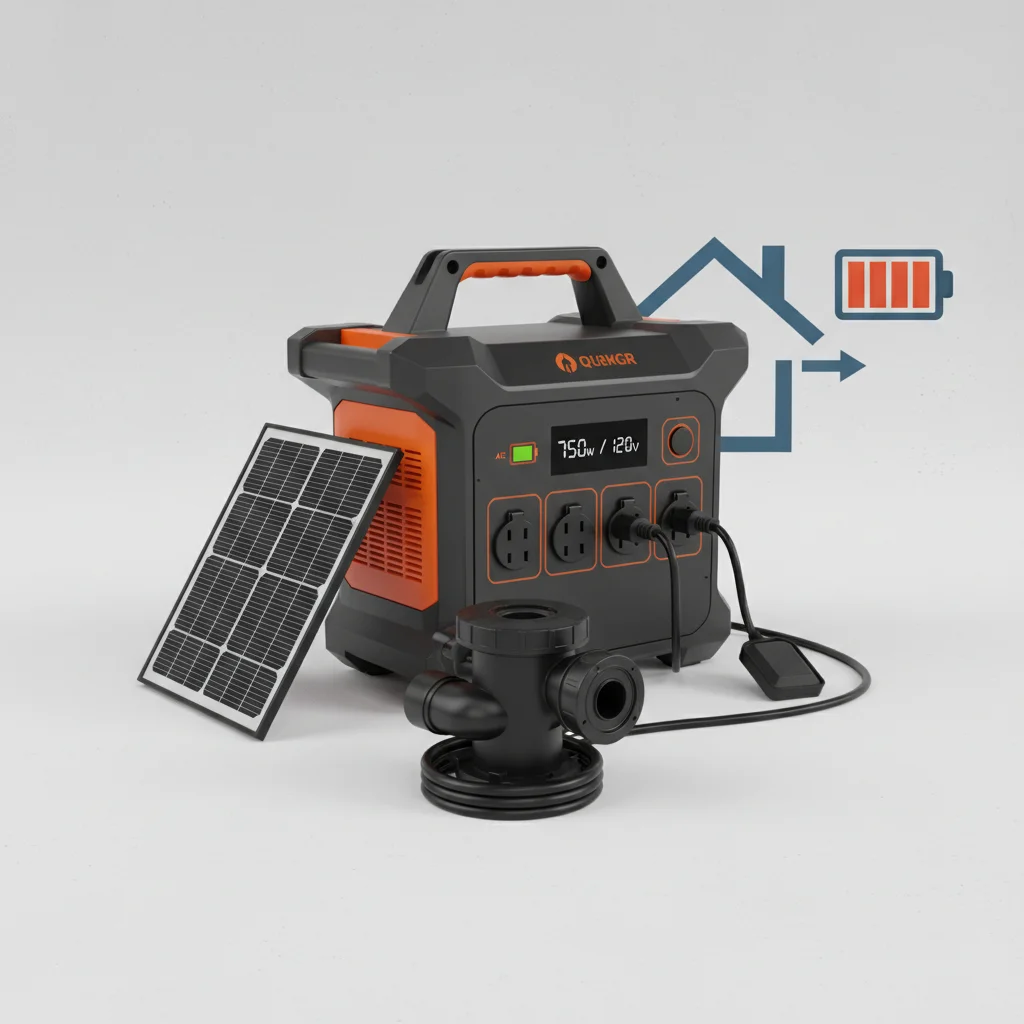
A portable power station can run a typical 1/3 HP sump pump for approximately 3 to 6 hours, depending on the power station’s capacity and the pump’s duty cycle. For a 1/2 HP sump pump, this duration might decrease to 2 to 4 hours. This estimate assumes the sump pump is not running continuously but rather cycling on and off as needed to remove water.
Understanding Sump Pump Power Requirements
Sump pumps are essential for preventing basement flooding, especially in areas prone to heavy rain. They typically come in two common sizes: 1/3 horsepower (HP) and 1/2 HP. A 1/3 HP sump pump generally draws between 800 to 1000 watts when running, while a 1/2 HP model can draw 1000 to 1500 watts. It’s crucial to note that the startup surge for a sump pump can be significantly higher, often 2-3 times its running wattage, which a portable power station must be able to handle. For more portable power guides on this site.
To accurately determine how long your specific sump pump will run, check its nameplate for exact wattage. Also, consider the frequency of its operation. In a heavy downpour, a sump pump might run more often, reducing the total runtime from a power station.
Calculating Runtime for Your Sump Pump
To calculate the approximate runtime, you’ll need the power station’s usable battery capacity (in Watt-hours, Wh) and the sump pump’s running wattage. The formula is: Runtime (hours) = Usable Battery Capacity (Wh) / Sump Pump Running Wattage (W). Remember to account for an inverter efficiency loss, typically around 10-15%. So, a more realistic calculation would be: Runtime = (Usable Battery Capacity * 0.85) / Sump Pump Running Wattage.
For example, a 1000Wh power station running a 1000W sump pump would last approximately 0.85 hours if running continuously. However, sump pumps cycle, so if it runs for 10 minutes every hour, the total duration the power station can support it would be much longer.
Key Features for Sump Pump Compatibility
|
Our Picks for the Best Power Station in 2026
As an Amazon Associate I earn from qualifying purchases.
|
||
| Num | Product | Action |
|---|---|---|
| 1 | 550W Power Station Compatible with Dewalt: LIVOWALNY Portable Generator DC 20V to AC 110-120V, Pure Sine Wave Power Inverter Battery Adapter Phone Charger 2 USB-A & 1 Type-C & 2 AC Outlet (Tool Only) |

|
| 2 | UGREEN Power Strip Surge Protector with 4 Power Outlets, 15w Wireless Charger, 20W PD3.0 USB C Fast Charging, 2 USB-C Ports, 2 USB A Ports, Desk Charging Station for Office, Conference, Home Use |
|
| 3 | Westinghouse 155Wh 150 Peak Watt Portable Power Station & Solar Generator, Modified Sine Wave AC Outlet, Backup Lithium Battery for Camping, Home, Travel, Indoor/Outdoor Use (Solar Panel Not Included) |
|
| 4 | Anker SOLIX C300 Portable Power Station with Car Charging Cable, Outdoor 288Wh LiFePO4 Battery, 300W (600W Surge) Solar Generator, 140W Two-Way Fast Charging, for Camping, Traveling, and Emergencies. |
|
| 5 | Anker SOLIX C1000 Gen 2 Portable Power Station, 2,000W (Peak 3,000W) Solar Generator, Full Charge in 49 Min, 1,024Wh LiFePO4 Battery for Home Backup, Power Outages, and Camping (Optional Solar Panel) |
|
| 6 | Jackery Explorer 2000 v2 Portable Power Station with 2x200W Solar Panels, 2042Wh LiFePo4 Battery, 2200W Solar Generator, 20ms UPS, USB-C PD 100W Fast Charging for Power Outages, Emergencies, Camping |
|
| 7 | Anker SOLIX C1000 Portable Power Station, 1800W (Peak 2400W) Solar Generator, Full Charge in 58 Min, 1056wh LiFePO4 Battery for Home Backup, Power Outages, and Outdoor Camping (Optional Solar Panel) |
|
| 8 | Anker SOLIX F3800 Portable Power Station, 3840Wh, LiFePO4 Batteries, Ultra-High 6000W AC Output with 120V/240V, Solar Generator for Home Backup, RVs, Emergencies, Power Outages, and Outdoor Camping |
|
| 9 | 550W Portable Power Inverter Compatible with Dewalt 20V Battery, Power Station DC 20V to AC 110V Pure Sine Wave, Battery Power Adapter 2USB&Type-C, Generator Phone Charger LED Light Camping Emergency |
|
| 10 | BLUETTI Portable Power Station AC180, 1152Wh LiFePO4 Battery Backup w/ 2 1800W (2700W peak) AC Outlets, 0-80% in 45Min, Solar Generator for Camping, Off-grid, Power Outage |
|
When selecting a portable power station for a sump pump, several features are paramount. First, ensure the power station has a high enough continuous output wattage to handle your pump’s running wattage and a surge capacity to manage its startup spike. Second, look for a large battery capacity (Wh) to provide extended runtime. Lastly, consider models with LiFePO4 batteries for longer cycle life and better performance in varying temperatures.
- High continuous wattage output (at least 1500W for 1/2 HP pumps)
- Robust surge capability (2000W+ recommended)
- Large battery capacity (1000Wh or more)
- LiFePO4 battery chemistry for durability
- Multiple AC outlets for flexibility
Recommended Portable Power Stations
For reliable sump pump operation during power outages, consider power stations with capacities of 1500Wh or more and continuous output of at least 1800W. These specifications ensure both adequate runtime and the ability to handle the pump’s initial power draw. Brands like EcoFlow, Jackery, and Bluetti offer models that fit these criteria, providing peace of mind during emergencies.
Always test your setup before an actual emergency. Run your sump pump with the portable power station for a short period to confirm compatibility and understand its real-world performance. This proactive step can prevent potential flooding and ensure your home remains dry.
Maintaining Your Power Station for Emergency Use
Regular maintenance of your portable power station is crucial, especially when it’s intended for emergency use with critical appliances like a sump pump. Keep the battery charged to at least 80% when not in use, and cycle it completely every few months to maintain battery health. Store it in a cool, dry place away from direct sunlight and extreme temperatures.
Periodically check the power station’s ports and cables for any signs of wear or damage. A well-maintained power station will be ready to perform when you need it most, providing reliable backup power for your sump pump and protecting your home from water damage.

This was super helpful in understanding the difference between 1/3 HP and 1/2 HP sump pump power draw. I always just assumed they were all the same. Knowing that a 1/2 HP model can draw up to 1500 watts helped me choose the right size power station. No more guessing games when the power goes out!
I was really worried about the startup surge for my 1/3 HP sump pump, but the power station I got (after reading about the wattage requirements here) handled it without a hitch. It’s great to know exactly what to look for. My only minor complaint is that the unit itself is a bit heavier than I expected, but it’s a small trade-off for keeping my basement dry.
I live in an area with frequent power outages, and my basement has flooded twice. This guide was a lifesaver. I picked up a 1500W portable power station, and it handled my 1/2 HP sump pump perfectly during the last storm. It ran for about 3.5 hours, just as the post suggested, cycling on and off. Peace of mind is priceless.
The info on how long a power station lasts for a sump pump was pretty accurate. I have a 1/3 HP pump, and my 1000W station gave me just under 4 hours of intermittent use. My main issue is that recharging the power station takes forever. I wish there were faster charging options for these larger units, especially when you need it ready for the next downpour.