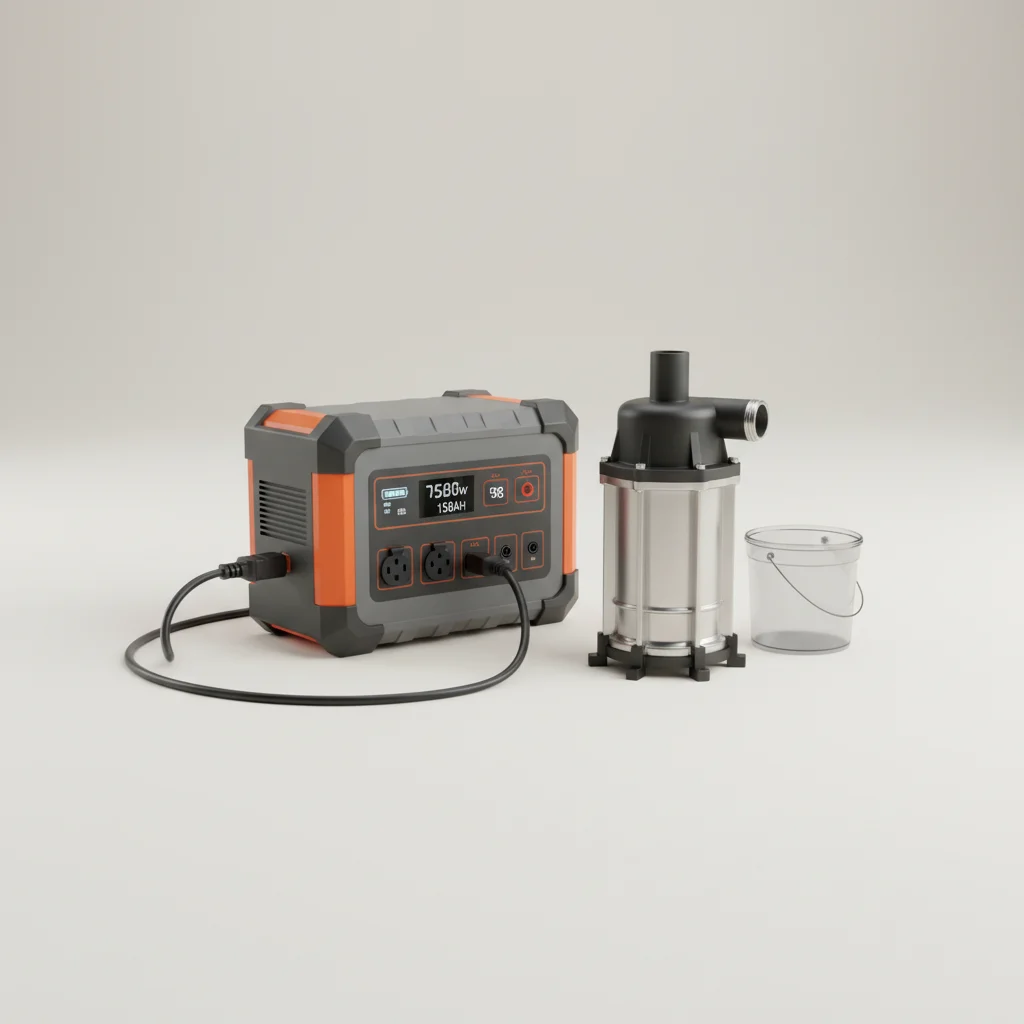
A portable power station can run a standard 1/3 HP sump pump for approximately 2 to 4 hours on a single charge, depending on the power station’s capacity and the pump’s duty cycle. For a 1/2 HP sump pump, this duration typically reduces to 1.5 to 3 hours. These estimates assume the pump is not running continuously but rather cycling on and off as needed to remove water.
Understanding Sump Pump Power Consumption
Sump pumps are essential for preventing basement flooding, especially during heavy rains. Their power consumption varies significantly based on their horsepower (HP) and efficiency. A typical 1/3 HP sump pump draws around 400-500 watts when running, while a 1/2 HP pump can draw 600-800 watts. It’s crucial to consider the surge wattage as well, which can be 2-3 times the running wattage when the pump first starts. Your portable power station must be able to handle both the continuous running wattage and the initial surge.
To accurately determine how long your power station will last, you need to know its total watt-hour (Wh) capacity. For example, a 1000Wh power station running a 500-watt sump pump continuously would theoretically last 2 hours (1000Wh / 500W = 2h). However, sump pumps cycle, meaning they only run when water levels rise. This intermittent operation extends the overall backup time considerably.
Calculating Runtime for Your Specific Setup
To get a more precise estimate, you’ll need two key pieces of information: your portable power station’s capacity in watt-hours (Wh) and your sump pump’s running wattage. Most sump pumps have this information on a label. If not, you can use a power meter to measure it directly. Once you have these figures, use the following formula:
- Runtime (hours) = Power Station Capacity (Wh) / Sump Pump Running Wattage (W)
- Remember to factor in an efficiency loss of about 10-15% for the inverter.
- Consider the duty cycle of your sump pump; it rarely runs 100% of the time.
- Account for the initial surge wattage when the pump starts.
- Ensure your power station’s output can handle the pump’s maximum draw.
For example, if your power station is 1500Wh and your sump pump draws 600W, the theoretical continuous runtime is 2.5 hours. If the pump runs for 10 minutes every hour, your power station could provide backup for much longer, potentially 15 hours or more, depending on the frequency of operation.
Factors Affecting Sump Pump Runtime
|
Our Picks for the Best Power Station in 2026
As an Amazon Associate I earn from qualifying purchases.
|
||
| Num | Product | Action |
|---|---|---|
| 1 | Westinghouse 155Wh 150 Peak Watt Portable Power Station & Solar Generator, Modified Sine Wave AC Outlet, Backup Lithium Battery for Camping, Home, Travel, Indoor/Outdoor Use (Solar Panel Not Included) |

|
| 2 | Anker SOLIX C1000 Portable Power Station, 1800W (Peak 2400W) Solar Generator, Full Charge in 58 Min, 1056wh LiFePO4 Battery for Home Backup, Power Outages, and Outdoor Camping (Optional Solar Panel) |
|
| 3 | 550W Power Station Compatible with Dewalt: LIVOWALNY Portable Generator DC 20V to AC 110-120V, Pure Sine Wave Power Inverter Battery Adapter Phone Charger 2 USB-A & 1 Type-C & 2 AC Outlet (Tool Only) |
|
| 4 | 550W Portable Power Inverter Compatible with Dewalt 20V Battery, Power Station DC 20V to AC 110V Pure Sine Wave, Battery Power Adapter 2USB&Type-C, Generator Phone Charger LED Light Camping Emergency |
|
| 5 | Jackery Explorer 2000 v2 Portable Power Station with 2x200W Solar Panels, 2042Wh LiFePo4 Battery, 2200W Solar Generator, 20ms UPS, USB-C PD 100W Fast Charging for Power Outages, Emergencies, Camping |
|
| 6 | Anker SOLIX C300 Portable Power Station with Car Charging Cable, Outdoor 288Wh LiFePO4 Battery, 300W (600W Surge) Solar Generator, 140W Two-Way Fast Charging, for Camping, Traveling, and Emergencies. |
|
| 7 | Anker SOLIX F3800 Portable Power Station, 3840Wh, LiFePO4 Batteries, Ultra-High 6000W AC Output with 120V/240V, Solar Generator for Home Backup, RVs, Emergencies, Power Outages, and Outdoor Camping |
|
| 8 | UGREEN Power Strip Surge Protector with 4 Power Outlets, 15w Wireless Charger, 20W PD3.0 USB C Fast Charging, 2 USB-C Ports, 2 USB A Ports, Desk Charging Station for Office, Conference, Home Use |
|
| 9 | Anker SOLIX C1000 Gen 2 Portable Power Station, 2,000W (Peak 3,000W) Solar Generator, Full Charge in 49 Min, 1,024Wh LiFePO4 Battery for Home Backup, Power Outages, and Camping (Optional Solar Panel) |
|
| 10 | BLUETTI Portable Power Station AC180, 1152Wh LiFePO4 Battery Backup w/ 2 1800W (2700W peak) AC Outlets, 0-80% in 45Min, Solar Generator for Camping, Off-grid, Power Outage |
|
Several factors can influence how long your portable power station will power your sump pump. The most significant is the power station’s capacity; larger capacities naturally offer longer runtimes. The efficiency of both the power station’s inverter and the sump pump itself also plays a role. Older or less efficient pumps will draw more power, reducing runtime.
Environmental conditions, such as extreme cold, can slightly reduce the efficiency of lithium-ion batteries in power stations. Additionally, if you’re powering other devices simultaneously from the same power station, the available power for the sump pump will decrease, shortening its operational period. Always prioritize the sump pump during a power outage to prevent flooding.
Choosing the Right Portable Power Station
When selecting a portable power station for sump pump backup, prioritize models with a high watt-hour (Wh) capacity and a robust inverter capable of handling the sump pump’s surge wattage. Look for power stations with pure sine wave inverters, which are safer for sensitive electronics and motors like those found in sump pumps. Consider models with multiple output ports, including AC outlets, to ensure compatibility.
For reliable sump pump backup, a power station with at least 1000Wh capacity and a continuous output of 1000W or more is generally recommended. If your sump pump is a 1/2 HP or larger, you might need a power station with 1500Wh or more and a higher continuous output to manage the increased power draw and surge.Additionally, consider models that support pass-through charging, allowing you to keep the power station plugged into a wall outlet while simultaneously powering the sump pump, ensuring it’s always ready for an outage.
Maintenance and Best Practices
To ensure your portable power station is ready when you need it most, regular maintenance is key. Keep the power station charged to at least 80% when not in use, and recharge it every 3-6 months if stored for long periods. Store it in a cool, dry place away from direct sunlight. Before an anticipated storm or power outage, fully charge your power station and test it with your sump pump to confirm compatibility and functionality.
It’s also wise to have a backup plan, such as a manual hand pump or a secondary battery-powered sump pump, especially if you live in an area prone to frequent or prolonged power outages. Understanding your sump pump’s specific power requirements and matching them with an appropriately sized portable power station will provide peace of mind during emergencies.
