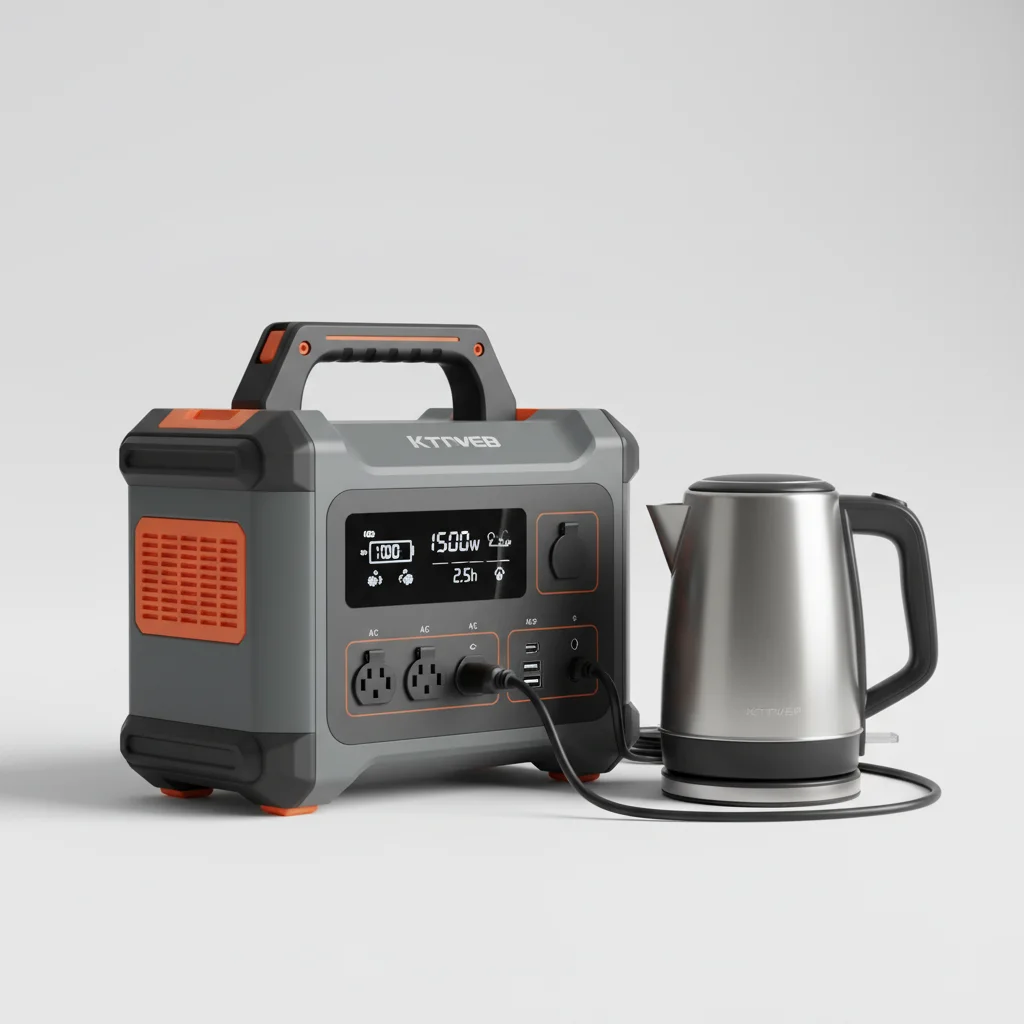
A portable power station can run an electric kettle for approximately 30 minutes to 2 hours, depending on the kettle’s wattage and the power station’s capacity. For example, a 1500W electric kettle used with a 1000Wh power station will last about 40 minutes, while a 750W kettle could run for over an hour. Understanding these factors is crucial for planning your off-grid hot beverage needs.
Understanding Electric Kettle Power Consumption
Electric kettles are known for their high power draw, typically ranging from 750W to 2000W. This high wattage allows them to heat water quickly but also means they consume a significant amount of energy in a short period. When selecting a portable power station, it’s essential to match its continuous output capacity with your kettle’s wattage to ensure it can handle the load. Attempting to run a kettle that exceeds the power station’s output can trigger overload protection, shutting down the unit.
Calculating Run Time for Your Electric Kettle
To accurately estimate how long your portable power station will run an electric kettle, you need to know both the power station’s usable capacity (in Watt-hours, Wh) and the kettle’s wattage (W). The formula is simple: Run Time (hours) = Usable Capacity (Wh) / Kettle Wattage (W). However, remember that this calculation provides a theoretical maximum. Real-world efficiency losses, typically around 10-20%, mean the actual run time will be slightly less. Always factor in a buffer for practical usage.
- Check your power station’s usable capacity (Wh).
- Locate your electric kettle’s wattage (W) on its label.
- Divide the power station’s Wh by the kettle’s W to get theoretical hours.
- Subtract 10-20% for real-world efficiency losses.
- Consider intermittent use for multiple heating cycles.
Choosing the Right Power Station Capacity
|
Our Picks for the Best Power Station in 2026
As an Amazon Associate I earn from qualifying purchases.
|
||
| Num | Product | Action |
|---|---|---|
| 1 | Anker SOLIX F3800 Portable Power Station, 3840Wh, LiFePO4 Batteries, Ultra-High 6000W AC Output with 120V/240V, Solar Generator for Home Backup, RVs, Emergencies, Power Outages, and Outdoor Camping |

|
| 2 | Jackery Explorer 2000 v2 Portable Power Station with 2x200W Solar Panels, 2042Wh LiFePo4 Battery, 2200W Solar Generator, 20ms UPS, USB-C PD 100W Fast Charging for Power Outages, Emergencies, Camping |
|
| 3 | Anker SOLIX C1000 Portable Power Station, 1800W (Peak 2400W) Solar Generator, Full Charge in 58 Min, 1056wh LiFePO4 Battery for Home Backup, Power Outages, and Outdoor Camping (Optional Solar Panel) |
|
| 4 | Westinghouse 155Wh 150 Peak Watt Portable Power Station & Solar Generator, Modified Sine Wave AC Outlet, Backup Lithium Battery for Camping, Home, Travel, Indoor/Outdoor Use (Solar Panel Not Included) |
|
| 5 | 550W Power Station Compatible with Dewalt: LIVOWALNY Portable Generator DC 20V to AC 110-120V, Pure Sine Wave Power Inverter Battery Adapter Phone Charger 2 USB-A & 1 Type-C & 2 AC Outlet (Tool Only) |
|
| 6 | Anker SOLIX C1000 Gen 2 Portable Power Station, 2,000W (Peak 3,000W) Solar Generator, Full Charge in 49 Min, 1,024Wh LiFePO4 Battery for Home Backup, Power Outages, and Camping (Optional Solar Panel) |
|
| 7 | UGREEN Power Strip Surge Protector with 4 Power Outlets, 15w Wireless Charger, 20W PD3.0 USB C Fast Charging, 2 USB-C Ports, 2 USB A Ports, Desk Charging Station for Office, Conference, Home Use |
|
| 8 | 550W Portable Power Inverter Compatible with Dewalt 20V Battery, Power Station DC 20V to AC 110V Pure Sine Wave, Battery Power Adapter 2USB&Type-C, Generator Phone Charger LED Light Camping Emergency |
|
| 9 | BLUETTI Portable Power Station AC180, 1152Wh LiFePO4 Battery Backup w/ 2 1800W (2700W peak) AC Outlets, 0-80% in 45Min, Solar Generator for Camping, Off-grid, Power Outage |
|
| 10 | Anker SOLIX C300 Portable Power Station with Car Charging Cable, Outdoor 288Wh LiFePO4 Battery, 300W (600W Surge) Solar Generator, 140W Two-Way Fast Charging, for Camping, Traveling, and Emergencies. |
|
For frequent electric kettle use, a portable power station with a capacity of at least 1000Wh is recommended. Smaller units, such as those in the 300-500Wh range, might only provide enough power for one or two quick boils before needing a recharge. If you plan to use your kettle multiple times a day or for extended periods, opting for a higher capacity unit, perhaps 1500Wh or more, will offer greater convenience and reliability. Consider your overall power needs for other appliances as well when making your decision.
Tips for Efficient Electric Kettle Use with a Power Station
To maximize the run time of your electric kettle with a portable power station, consider these efficiency tips. Only boil the amount of water you need, as heating less water requires less energy. Pre-heating water in a solar kettle or on a camp stove before transferring it to the electric kettle for a final boil can also save significant power. Additionally, ensure your power station is fully charged before use, especially if you anticipate multiple boiling cycles. Regularly maintaining both your kettle and power station will also contribute to optimal performance.
Alternative Heating Methods for Off-Grid Living
While portable power stations offer convenience, exploring alternative heating methods can further extend your off-grid capabilities. Propane or butane camp stoves are highly efficient for boiling water and don’t draw from your electrical reserves. Solar kettles or parabolic solar concentrators can harness the sun’s energy to heat water without any fuel or electricity. For longer-term off-grid setups, a wood-burning stove with a water jacket can provide both heat and hot water. Integrating these methods can reduce reliance on your power station for high-draw appliances like electric kettles.
