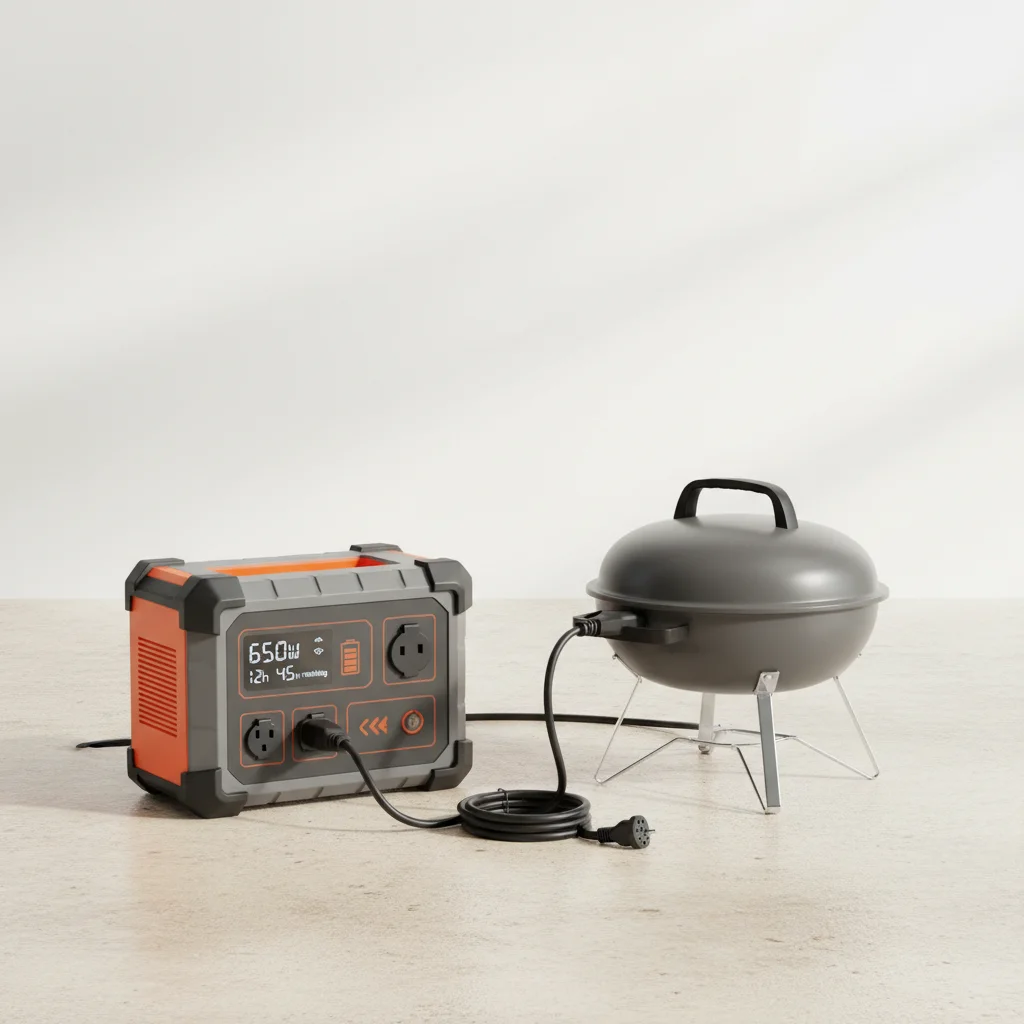
A portable power station can run an electric grill for approximately 1 to 3 hours, depending on the grill’s wattage and the power station’s capacity. For instance, a 1500Wh power station can power a 1000W electric grill for about 1.5 hours. Understanding the power requirements of your grill and the output capabilities of your power station is crucial for successful outdoor cooking.
Understanding Electric Grill Power Consumption
Electric grills are convenient for outdoor cooking, but they can be power-hungry appliances. Most electric grills draw between 1000W and 1500W of power. This high wattage means they will deplete a portable power station’s battery relatively quickly compared to lower-wattage devices. Always check the specific wattage of your electric grill, usually found on a label on the appliance or in its user manual, to accurately estimate run time.
Calculating Run Time for Your Setup
To determine how long your portable power station will power your electric grill, you’ll need to perform a simple calculation. Divide the power station’s usable capacity (in Watt-hours, Wh) by the electric grill’s wattage (in Watts, W). For example, if you have a 1000Wh power station and a 1200W electric grill, the theoretical run time is 1000Wh / 1200W = 0.83 hours, or about 50 minutes. Remember to account for inverter efficiency losses, which typically reduce the actual run time by 10-20%.
Factors Affecting Power Station Performance
|
Our Picks for the Best Power Station in 2026
As an Amazon Associate I earn from qualifying purchases.
|
||
| Num | Product | Action |
|---|---|---|
| 1 | Anker SOLIX C1000 Gen 2 Portable Power Station, 2,000W (Peak 3,000W) Solar Generator, Full Charge in 49 Min, 1,024Wh LiFePO4 Battery for Home Backup, Power Outages, and Camping (Optional Solar Panel) |

|
| 2 | Westinghouse 155Wh 150 Peak Watt Portable Power Station & Solar Generator, Modified Sine Wave AC Outlet, Backup Lithium Battery for Camping, Home, Travel, Indoor/Outdoor Use (Solar Panel Not Included) |
|
| 3 | 550W Power Station Compatible with Dewalt: LIVOWALNY Portable Generator DC 20V to AC 110-120V, Pure Sine Wave Power Inverter Battery Adapter Phone Charger 2 USB-A & 1 Type-C & 2 AC Outlet (Tool Only) |
|
| 4 | BLUETTI Portable Power Station AC180, 1152Wh LiFePO4 Battery Backup w/ 2 1800W (2700W peak) AC Outlets, 0-80% in 45Min, Solar Generator for Camping, Off-grid, Power Outage |
|
| 5 | 550W Portable Power Inverter Compatible with Dewalt 20V Battery, Power Station DC 20V to AC 110V Pure Sine Wave, Battery Power Adapter 2USB&Type-C, Generator Phone Charger LED Light Camping Emergency |
|
| 6 | Anker SOLIX C1000 Portable Power Station, 1800W (Peak 2400W) Solar Generator, Full Charge in 58 Min, 1056wh LiFePO4 Battery for Home Backup, Power Outages, and Outdoor Camping (Optional Solar Panel) |
|
| 7 | UGREEN Power Strip Surge Protector with 4 Power Outlets, 15w Wireless Charger, 20W PD3.0 USB C Fast Charging, 2 USB-C Ports, 2 USB A Ports, Desk Charging Station for Office, Conference, Home Use |
|
| 8 | Anker SOLIX C300 Portable Power Station with Car Charging Cable, Outdoor 288Wh LiFePO4 Battery, 300W (600W Surge) Solar Generator, 140W Two-Way Fast Charging, for Camping, Traveling, and Emergencies. |
|
| 9 | Anker SOLIX F3800 Portable Power Station, 3840Wh, LiFePO4 Batteries, Ultra-High 6000W AC Output with 120V/240V, Solar Generator for Home Backup, RVs, Emergencies, Power Outages, and Outdoor Camping |
|
| 10 | Jackery Explorer 2000 v2 Portable Power Station with 2x200W Solar Panels, 2042Wh LiFePo4 Battery, 2200W Solar Generator, 20ms UPS, USB-C PD 100W Fast Charging for Power Outages, Emergencies, Camping |
|
Several factors can influence how long your portable power station will run an electric grill. The ambient temperature, the age and health of the power station’s battery, and whether you are simultaneously powering other devices will all play a role. Cold temperatures can reduce battery efficiency, while older batteries may not hold a full charge. Using the grill on a lower heat setting, if available, can also extend run time.
Choosing the Right Power Station for Grilling
When selecting a portable power station for an electric grill, prioritize models with high capacity (at least 1000Wh, ideally 1500Wh or more) and a robust inverter that can handle the grill’s peak wattage. Look for power stations with pure sine wave inverters to ensure stable power delivery, which is better for sensitive electronics. Consider models with multiple AC outlets if you plan to power other small appliances alongside your grill.
- Check the grill’s wattage before purchasing a power station.
- Opt for power stations with at least 1000Wh capacity.
- Ensure the power station’s inverter can handle the grill’s peak draw.
- Consider models with LiFePO4 batteries for longer lifespan.
- Look for multiple AC outlets for versatility.
Tips for Efficient Grilling with a Power Station
To maximize the run time of your portable power station while grilling, preheat your grill using shore power if possible, or minimize preheating time when running on battery. Cook in batches to reduce continuous power draw, and keep the grill lid closed as much as possible to retain heat. If your grill has variable temperature settings, use the lowest effective setting.Additionally, consider bringing a backup power source or a solar panel for recharging if you plan for extended grilling sessions off-grid.

The calculations for run time were very useful, especially understanding how a 1500Wh station powers a 1000W grill. However, I found that even with a fully charged station, my grill sometimes pulls more power than expected, cutting the time a bit short. It’s still better than nothing, but I had to adjust my expectations slightly.
I’ve been looking for a reliable way to use my electric grill when camping without hookups, and this really helped clarify things. I have a 1200W grill, and knowing a 1500Wh power station can give me about 1.25 hours is super helpful for planning meals. No more guessing games, just delicious grilled food in the wilderness!
Finally, a clear explanation of how long a portable power station will actually last with an electric grill! I always wondered if my 1000W grill would drain my battery too fast. Now I understand the 1 to 3 hour range is pretty accurate depending on the station’s capacity. Great info for my backyard cookouts when I don’t want to run an extension cord.
This was a good breakdown. I appreciate the emphasis on checking the grill’s wattage; it’s something a lot of people overlook. My only minor gripe is that I wish there were more specific brand recommendations for power stations that handle high wattage well. Still, it’s a solid guide for anyone wanting to grill off-grid.