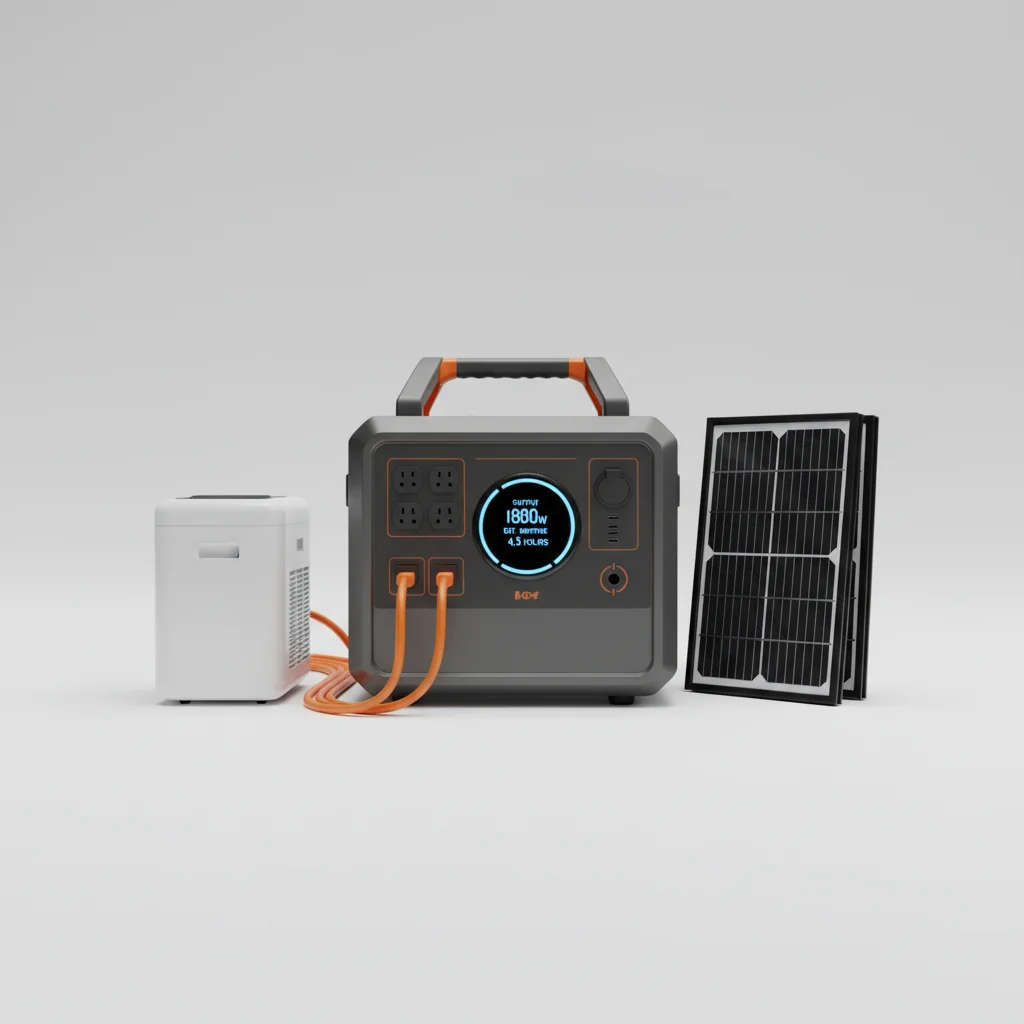
A portable power station can run a small portable air conditioner for approximately 3 to 8 hours, depending on the power station’s capacity and the AC unit’s wattage. For instance, a 1500Wh power station might power a 500W portable AC for about 3 hours, while a 2000Wh unit could extend that to 4 hours or more, considering efficiency losses.
Understanding Air Conditioner Power Consumption
Portable air conditioners are significant power consumers, typically drawing between 500W and 1500W. Mini-split or window units designed for small spaces tend to be on the lower end, while larger, more powerful units will demand more. It’s crucial to check the specific wattage of your air conditioner, usually found on a label on the unit or in its manual, to accurately estimate runtime with a portable power station.
Factors like the ambient temperature, the size of the space being cooled, and the AC unit’s efficiency rating (EER or SEER) also influence actual power draw. Running an AC on its lowest fan setting or in eco-mode can extend the runtime from your power station.
Calculating Runtime for Your Setup
To calculate how long your portable power station can run your air conditioner, use a simple formula: (Power Station Capacity in Wh * 0.85) / AC Unit Wattage in W = Estimated Runtime in Hours. The 0.85 factor accounts for an average 15% power loss due to inverter inefficiency and other system overheads.
- Identify your power station’s usable capacity in Watt-hours (Wh).
- Find your air conditioner’s running wattage (not surge wattage).
- Apply the efficiency factor (typically 0.85 for 85% efficiency).
- Divide the effective power station capacity by the AC’s wattage.
- Consider peak usage vs. average usage for more accurate estimates.
For example, a 2000Wh power station running a 600W portable AC: (2000 Wh * 0.85) / 600 W = 1700 Wh / 600 W = 2.83 hours. This calculation provides a realistic baseline for planning your cooling needs.
Optimizing Power Station Performance for AC Units
|
Our Picks for the Best Power Station in 2026
As an Amazon Associate I earn from qualifying purchases.
|
||
| Num | Product | Action |
|---|---|---|
| 1 | Jackery Explorer 2000 v2 Portable Power Station with 2x200W Solar Panels, 2042Wh LiFePo4 Battery, 2200W Solar Generator, 20ms UPS, USB-C PD 100W Fast Charging for Power Outages, Emergencies, Camping |

|
| 2 | Anker SOLIX C1000 Portable Power Station, 1800W (Peak 2400W) Solar Generator, Full Charge in 58 Min, 1056wh LiFePO4 Battery for Home Backup, Power Outages, and Outdoor Camping (Optional Solar Panel) |
|
| 3 | BLUETTI Portable Power Station AC180, 1152Wh LiFePO4 Battery Backup w/ 2 1800W (2700W peak) AC Outlets, 0-80% in 45Min, Solar Generator for Camping, Off-grid, Power Outage |
|
| 4 | Anker SOLIX F3800 Portable Power Station, 3840Wh, LiFePO4 Batteries, Ultra-High 6000W AC Output with 120V/240V, Solar Generator for Home Backup, RVs, Emergencies, Power Outages, and Outdoor Camping |
|
| 5 | Westinghouse 155Wh 150 Peak Watt Portable Power Station & Solar Generator, Modified Sine Wave AC Outlet, Backup Lithium Battery for Camping, Home, Travel, Indoor/Outdoor Use (Solar Panel Not Included) |
|
| 6 | 550W Portable Power Inverter Compatible with Dewalt 20V Battery, Power Station DC 20V to AC 110V Pure Sine Wave, Battery Power Adapter 2USB&Type-C, Generator Phone Charger LED Light Camping Emergency |
|
| 7 | Anker SOLIX C300 Portable Power Station with Car Charging Cable, Outdoor 288Wh LiFePO4 Battery, 300W (600W Surge) Solar Generator, 140W Two-Way Fast Charging, for Camping, Traveling, and Emergencies. |
|
| 8 | UGREEN Power Strip Surge Protector with 4 Power Outlets, 15w Wireless Charger, 20W PD3.0 USB C Fast Charging, 2 USB-C Ports, 2 USB A Ports, Desk Charging Station for Office, Conference, Home Use |
|
| 9 | Anker SOLIX C1000 Gen 2 Portable Power Station, 2,000W (Peak 3,000W) Solar Generator, Full Charge in 49 Min, 1,024Wh LiFePO4 Battery for Home Backup, Power Outages, and Camping (Optional Solar Panel) |
|
| 10 | 550W Power Station Compatible with Dewalt: LIVOWALNY Portable Generator DC 20V to AC 110-120V, Pure Sine Wave Power Inverter Battery Adapter Phone Charger 2 USB-A & 1 Type-C & 2 AC Outlet (Tool Only) |
|
To maximize the runtime of your portable power station when powering an air conditioner, consider several strategies. First, pre-cool the space before relying solely on the power station. If possible, use the AC in a well-insulated room to reduce its workload. Setting the thermostat a few degrees higher than your ideal comfort level can also significantly reduce power consumption.
Additionally, ensure your power station is fully charged before use. Some power stations offer pass-through charging, allowing them to be charged by solar panels while simultaneously powering your AC, which can extend runtime indefinitely under good sunlight conditions.
Choosing the Right Power Station for AC Use
When selecting a portable power station specifically for running an air conditioner, prioritize models with high Watt-hour (Wh) capacities and robust inverter capabilities. Look for power stations with at least 1500Wh capacity and a continuous output wattage that exceeds your AC unit’s running wattage. A pure sine wave inverter is also essential for sensitive electronics like air conditioners, ensuring stable and clean power delivery.
Consider models with LiFePO4 batteries for longer cycle life and better safety. Features like multiple AC outlets and fast charging capabilities can also enhance usability. Always check user reviews and product specifications to ensure the power station can handle the sustained load of an air conditioner.
Alternative Cooling Solutions and Considerations
If running a portable air conditioner proves too demanding for your power station, consider alternative cooling methods. Evaporative coolers (swamp coolers) consume significantly less power, though they are only effective in dry climates. Small USB-powered fans or battery-operated fans can also provide localized relief without heavily draining your power station.
For extended off-grid cooling, integrating a larger solar generator system with multiple solar panels and a higher capacity battery bank might be a more sustainable solution. Always monitor your power station’s battery level and avoid deep discharges to prolong its lifespan.
