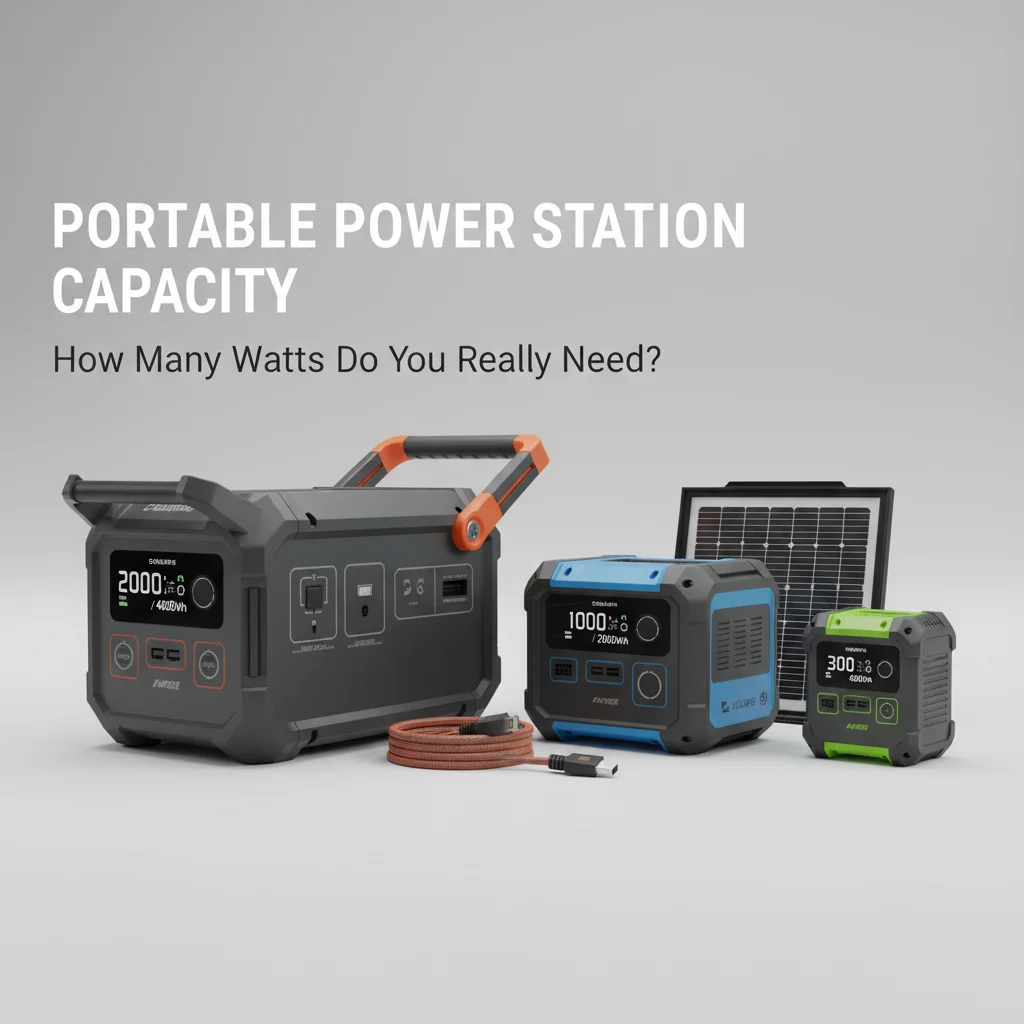
Determining the ideal portable power station capacity depends entirely on your specific power needs and the devices you plan to run. For light use, such as charging phones and laptops during a weekend trip, a 300-500Wh unit is often sufficient. However, for powering larger appliances like mini-fridges or CPAP machines for extended periods, you’ll likely need a unit with 1000Wh or more.
Understanding Watt-Hours (Wh) and Watts (W)
When evaluating portable power stations, you’ll encounter two key metrics: Watt-hours (Wh) and Watts (W). Watt-hours indicate the total energy storage capacity of the battery, essentially how long it can supply power. Watts, on the other hand, represent the maximum power output the inverter can deliver at any given moment. A higher Wh rating means more run time, while a higher W rating allows you to power more demanding appliances.
Consider the devices you intend to power. A smartphone might draw 5-10W, a laptop 40-60W, and a mini-fridge around 50-100W when running. Summing the wattage of your most critical devices will give you a baseline for the continuous output (W) you need. Then, estimate how long you’ll need to run them to determine the necessary Wh capacity.
Calculating Your Power Needs
To accurately calculate your power needs, list all the devices you plan to power and their respective wattages. You can usually find this information on the device itself, in its manual, or by using a power meter. For intermittent use, such as charging a phone multiple times, estimate the total Wh consumed over your desired period. For continuous use, multiply the device’s wattage by the number of hours you need it to run.
For example, if you want to run a 60W laptop for 5 hours, you’ll need 300Wh (60W x 5h). If you also want to charge a 10W phone for 2 hours, that’s an additional 20Wh. Always add a buffer of 20-30% to your total calculated Wh to account for inverter inefficiencies and unexpected usage.
Common Capacity Tiers and Their Uses
|
Our Picks for the Best Power Station in 2026
As an Amazon Associate I earn from qualifying purchases.
|
||
| Num | Product | Action |
|---|---|---|
| 1 | UGREEN Power Strip Surge Protector with 4 Power Outlets, 15w Wireless Charger, 20W PD3.0 USB C Fast Charging, 2 USB-C Ports, 2 USB A Ports, Desk Charging Station for Office, Conference, Home Use |

|
| 2 | Anker SOLIX C1000 Gen 2 Portable Power Station, 2,000W (Peak 3,000W) Solar Generator, Full Charge in 49 Min, 1,024Wh LiFePO4 Battery for Home Backup, Power Outages, and Camping (Optional Solar Panel) |
|
| 3 | Anker SOLIX C1000 Portable Power Station, 1800W (Peak 2400W) Solar Generator, Full Charge in 58 Min, 1056wh LiFePO4 Battery for Home Backup, Power Outages, and Outdoor Camping (Optional Solar Panel) |
|
| 4 | Anker SOLIX C300 Portable Power Station with Car Charging Cable, Outdoor 288Wh LiFePO4 Battery, 300W (600W Surge) Solar Generator, 140W Two-Way Fast Charging, for Camping, Traveling, and Emergencies. |
|
| 5 | Jackery Explorer 2000 v2 Portable Power Station with 2x200W Solar Panels, 2042Wh LiFePo4 Battery, 2200W Solar Generator, 20ms UPS, USB-C PD 100W Fast Charging for Power Outages, Emergencies, Camping |
|
| 6 | Anker SOLIX F3800 Portable Power Station, 3840Wh, LiFePO4 Batteries, Ultra-High 6000W AC Output with 120V/240V, Solar Generator for Home Backup, RVs, Emergencies, Power Outages, and Outdoor Camping |
|
| 7 | BLUETTI Portable Power Station AC180, 1152Wh LiFePO4 Battery Backup w/ 2 1800W (2700W peak) AC Outlets, 0-80% in 45Min, Solar Generator for Camping, Off-grid, Power Outage |
|
| 8 | 550W Portable Power Inverter Compatible with Dewalt 20V Battery, Power Station DC 20V to AC 110V Pure Sine Wave, Battery Power Adapter 2USB&Type-C, Generator Phone Charger LED Light Camping Emergency |
|
| 9 | 550W Power Station Compatible with Dewalt: LIVOWALNY Portable Generator DC 20V to AC 110-120V, Pure Sine Wave Power Inverter Battery Adapter Phone Charger 2 USB-A & 1 Type-C & 2 AC Outlet (Tool Only) |
|
| 10 | Westinghouse 155Wh 150 Peak Watt Portable Power Station & Solar Generator, Modified Sine Wave AC Outlet, Backup Lithium Battery for Camping, Home, Travel, Indoor/Outdoor Use (Solar Panel Not Included) |
|
- 200-500Wh: Ideal for charging small electronics, drones, and powering LED lights for short camping trips or emergencies.
- 500-1000Wh: Suitable for powering laptops, CPAP machines, small fans, and mini-fridges for a day or two.
- 1000-2000Wh: Great for extended camping, RV trips, or as a backup for essential home appliances during short power outages.
- 2000Wh+: Designed for serious off-grid living, extended home backup, or powering multiple high-draw appliances simultaneously.
Choosing the right capacity prevents both underpowering your needs and overspending on unnecessary capacity. It’s a balance between portability, cost, and functionality.
Factors Influencing Your Capacity Choice
Beyond just the wattage of your devices, several other factors should influence your portable power station capacity choice. Consider the duration of use: a weekend camping trip requires less capacity than a week-long off-grid adventure. The climate also plays a role; colder temperatures can reduce battery efficiency, meaning you might need a slightly larger capacity in such conditions. Finally, future-proofing is important. If you anticipate acquiring more power-hungry devices, it might be wise to invest in a slightly larger unit now.
Think about the recharge options available to you. If you have reliable access to solar panels or a car charger, you might be able to get by with a smaller capacity unit that you can frequently top up. However, if you’re in a remote location with limited recharging opportunities, a larger initial capacity is crucial.
Making the Right Decision for Your Needs
Ultimately, the

I finally pulled the trigger on a 1200Wh unit after reading up on the different capacities. It’s been a game-changer for our off-grid cabin. We can run our mini-fridge and charge all our devices without any issues. The peace of mind knowing we have reliable power is priceless.
This really helped me understand the difference between Watt-hours and Watts. I was originally looking at a smaller unit, but realized I needed something with a higher W rating to handle my power tools. Ended up with a 750W output model and it’s perfect for my workshop. Only wish it had a few more AC outlets.
For anyone needing to power a CPAP machine overnight, definitely go for 1000Wh or more. I learned that the hard way with a smaller unit that barely made it through. Upgraded to a larger capacity and now I sleep soundly knowing my machine will run all night. Don’t skimp on the Wh if you have critical medical devices.
I got a 400Wh unit for weekend camping trips, mostly for charging phones and a small fan. It works fine for that, but I found it struggles a bit if I try to run my laptop for too long while also charging other things. Next time I’ll probably go for something closer to 600Wh for a bit more flexibility.