Choosing between Jackery and EcoFlow portable power stations depends on prioritizing specific features for your off-grid living or backup power needs. Jackery excels in portability and rugged design, ideal for casual camping and straightforward backup, while EcoFlow leads with faster charging, higher power output, and extensive expandability, suited for demanding users and scalable home backup. Both brands now primarily use LiFePO4 batteries for enhanced longevity, offering 3000-4000 charge cycles.
Power Station: A Comprehensive Portable Energy Solution
A power station, often referred to as a solar generator or portable power bank, is a sophisticated device designed to store electrical energy and deliver it to various electronic devices and appliances. Unlike traditional gas generators, power stations operate silently, produce zero emissions, and can be recharged from multiple sources, making them a cleaner and more versatile alternative. At their core, these units consist of several main components: a high-capacity battery, an inverter to convert DC battery power into usable AC household current, a charge controller to manage incoming power from solar panels or wall outlets, and an array of output ports to connect your devices. They come in various sizes and capacities, from compact units for charging phones to large systems capable of powering entire homes during outages.
What is a Power Station?
A power station is essentially a large, rechargeable battery pack equipped with an inverter and multiple outlets, providing portable AC and DC power wherever you need it. It acts as an off-grid power source, allowing you to run everything from smartphones and laptops to refrigerators and power tools.
Key components typically include:
- Battery Cells: The energy storage component, increasingly utilizing Lithium Iron Phosphate (LiFePO4) chemistry for enhanced longevity and safety.
- Inverter: Converts the battery’s direct current (DC) into alternating current (AC) suitable for household electronics.
- Charge Controller: Optimizes incoming power from solar panels or wall chargers to efficiently replenish the battery.
- Output Ports: A diverse range of connections, including AC outlets, DC ports (12V car ports), USB-A, and high-speed USB-C ports.
- Battery Management System (BMS): An internal safeguard that monitors voltage, current, temperature, and overall battery health to prevent overcharging, over-discharging, and overheating.
- Display Screen: Provides real-time information on power input/output, remaining battery capacity, and charging status.
Power stations can be broadly classified by their capacity (Watt-hours) and inverter output (Watts), dictating the types and number of devices they can power and for how long.
Benefits of Using a Power Station
The adoption of portable power stations has surged due to their numerous advantages across various scenarios:
- Reliable Backup Power: In the event of grid power failures, a power station ensures essential home appliances like refrigerators, lights, and medical devices remain operational, providing crucial peace of mind.
- Sustainable Energy Source: When paired with solar panels, power stations harness clean, renewable energy, reducing reliance on fossil fuels and lowering your carbon footprint.
- Ultimate Portability: Designed for mobility, these units are indispensable companions for outdoor adventures such as camping, tailgating, and RVing, allowing you to bring modern conveniences anywhere.
- Uninterrupted Device Operation: For professionals working remotely or photographers in the field, a power station guarantees continuous operation of laptops, cameras, and drones, preventing workflow interruptions.
- Cost-Effectiveness: While an initial investment, power stations offer long-term savings by reducing the need for costly fuel and providing a reusable energy solution for years.
Comparing Jackery and EcoFlow: Key Factors to Consider
Choosing between Jackery and EcoFlow often comes down to prioritizing certain features over others. Both brands excel in different areas, catering to a spectrum of user needs. Here’s a breakdown of the critical factors to evaluate:
Capacity and Power Output
The capacity (measured in Watt-hours, Wh) determines how long a power station can run your devices, while the power output (measured in Watts, W) indicates which devices it can power.
- Jackery: Traditionally known for reliable mid-range capacities. Models like the Explorer 1000 v2 (1068Wh) and Explorer 2000 v2 (2042Wh) offer substantial power for camping and moderate home backup. The Explorer 2000 v2 provides 2200W continuous AC output with a 4100W surge, suitable for most household appliances. Jackery’s newer “Plus” and “v2” series significantly boost both capacity and output from earlier models.
- EcoFlow: Often pushes the boundaries with higher capacities and greater power output, catering to more demanding users. The DELTA 2 offers 1024Wh with 1800W continuous output (2700W surge), while the DELTA 3 Max Plus boasts 2048Wh and 3000W output (6000W surge). The top-tier DELTA 3 Ultra Plus offers a massive 3072Wh with 3600W continuous output (7200W surge), capable of running high-wattage appliances like air conditioners and power tools.
Battery Technology and Lifespan
The type of battery chemistry directly impacts the unit’s longevity and performance.
- Jackery: While older models primarily used NCM (Lithium-ion) batteries with about 500-800 charge cycles, Jackery’s newer “Plus” and “v2” series (e.g., Explorer 1000 Plus, Explorer 2000 v2) have transitioned to Lithium Iron Phosphate (LiFePO4 or LFP) batteries. This upgrade dramatically extends their lifespan to 3000-4000 cycles before degrading to 70-80% capacity, offering 10+ years of reliable use.
- EcoFlow: Almost all new EcoFlow models, including the RIVER and DELTA series, utilize LiFePO4 batteries. These are rated for 3000+ cycles to 80% capacity, matching or exceeding industry standards for durability and long-term value. LFP batteries are also known for their enhanced safety and thermal stability.
Charging Speed and Options
How quickly and flexibly a power station can recharge is a crucial differentiator.
- AC Wall Charging: EcoFlow is the undisputed leader in AC charging speed with its “X-Stream” technology, often achieving 0-100% in just 60-75 minutes for many of its DELTA series models. Jackery has made significant strides with its v2 models, which can now charge from 0-100% in 1.3 to 1.7 hours, a considerable improvement over earlier units that took 6-8 hours.
- Solar Charging: EcoFlow generally supports higher solar input, allowing for faster recharges. For example, the DELTA 2 accepts up to 500W solar input, while the DELTA 3 Ultra Plus can handle up to 1600W with specific panel configurations. This translates to full solar recharges in 2-3 hours for many models. Jackery’s solar input can be lower (e.g., Explorer 1000 v2 at 200W, Explorer 2000 v2 at 400W), typically requiring 6-7 hours for a full charge, though some Pro models could accept up to 800W.
- Car and Other Charging: Both brands support charging via a 12V car outlet. EcoFlow’s larger models also boast unique options like EV charger compatibility.
Portability and Design
The physical attributes of a power station are essential for its intended use.
- Jackery: Renowned for its rugged, user-friendly design. Jackery units typically feature a distinct orange and black aesthetic, robust carry handles, and a generally lighter build, making them highly portable and ideal for hikers and campers. Their design prioritizes ease of transport and durability in outdoor environments.
- EcoFlow: Offers a sleeker, more modern industrial design. Many EcoFlow models feature flat tops, allowing for convenient stacking, and larger units like the DELTA 3 Ultra Plus include integrated telescoping handles and wheels for easier transport despite their heavier weight. EcoFlow often incorporates more ports and advanced displays.
Expandability and Smart Features
Advanced functionalities enhance the versatility and user experience of power stations.
- Jackery: Historically, Jackery models have had fixed battery capacities. However, newer “Plus” series models now offer expandability with additional battery packs, though this feature is less pervasive across their lineup than with EcoFlow. Jackery also provides app control via Wi-Fi and Bluetooth on its latest models, along with UPS functionality.
- EcoFlow: A leader in expandability, many DELTA series units can connect to extra batteries to significantly boost total capacity (e.g., DELTA 2 Max up to 6kWh, DELTA Pro up to 25kWh), making them suitable for prolonged off-grid living or extensive home backup. EcoFlow excels in smart features, offering comprehensive app control (Wi-Fi and Bluetooth), a robust UPS (Uninterruptible Power Supply) function with sub-10ms switchover for critical devices, and advanced power management options.
Durability and Build Quality
Both brands design their power stations for demanding conditions, but with subtle differences.
- Jackery: Known for its robust and reliable construction, often perceived as more “rugged” for direct outdoor exposure. The structural integrity is designed to handle bumps and jostles of adventurous use.
- EcoFlow: Build quality is high, with models like the DELTA 3 series undergoing rigorous testing, including resistance to salt spray and substantial continuous weight. Their internal components often feature advanced cooling and automotive-grade LFP cells for enhanced safety and performance even in varied conditions. Many EcoFlow units are also surprisingly quiet under load.
Price and Value
The cost-effectiveness of a power station is a significant consideration.
- Jackery: Often positioned as a more budget-friendly option, providing excellent value for its reliable performance and portability, particularly for casual users.
- EcoFlow: While often commanding a higher price point due to its advanced technology, faster charging, and expandability, EcoFlow offers entry-level models like the DELTA 3 Classic at very competitive prices. The value proposition for EcoFlow lies in its cutting-edge features and scalability for power-intensive applications.
Jackery vs. EcoFlow: A Detailed Comparison
To highlight the differences, let’s compare some popular models from both brands.
| Feature | Jackery Explorer 1000 v2 | EcoFlow DELTA 2 | Jackery Explorer 2000 v2 | EcoFlow DELTA 3 Max Plus |
|---|---|---|---|---|
| Capacity | 1068Wh | 1024Wh (expandable to 3kWh+) | 2042Wh | 2048Wh (expandable to 5kWh+) |
| AC Output | 1500W (3000W Surge) | 1800W (2700W Surge with X-Boost) | 2200W (4100W Surge) | 3000W (6000W Surge) |
| Battery Type | LiFePO4 | LiFePO4 | LiFePO4 | LiFePO4 |
| Lifespan | 4000 cycles to 70% | 3000 cycles to 80% | 4000 cycles to 70% | 3000 cycles to 80% |
| AC Charge Time | ~1.7 hours (0-100%) | ~1.2 hours (0-100%) | ~2 hours (0-100%) | ~75 minutes (0-100%) |
| Max Solar Input | 200W | 500W | 400W | 1000W |
| Portability | Lightweight, rugged handle | Slightly heavier, stackable | Robust, moderate weight | Heavier, sometimes with wheels |
| Expandability | Limited/Newer models only | Yes, with extra batteries | Limited/Newer models only | Yes, with extra batteries |
| Smart Features | App control, UPS | App control, X-Stream, X-Boost, UPS | App control, UPS | App control, X-Stream, X-Boost, UPS |
| Best For | Casual camping, portable backup | Versatile use, faster charging | Extended camping, moderate home backup | High-demand users, RVs, home backup |
Power Station Buying Guide: Making the Right Choice
Selecting the ideal power station requires a systematic approach tailored to your individual needs. Here’s a comprehensive buying guide:
1. Determine Your Specific Needs
- Usage Scenario: Are you primarily a casual camper, an extensive RVer, an off-grid homeowner, or preparing for emergency home backup?
- Devices to Power: List all the devices and appliances you intend to run. Note their wattage (W) and how long (hours) you need to power them to calculate total Watt-hours (Wh) required. For example, a 60W portable fridge running for 10 hours needs 600Wh.
- Portability Requirements: Do you need a lightweight unit for backpacking, or can you manage a heavier system with wheels for RVing or home use?
2. Compare Key Specifications
Based on your needs, scrutinize these technical details:
- Capacity (Wh): Choose a capacity that comfortably covers your calculated energy needs for the desired duration. It’s often wise to have a buffer.
- Power Output (W): Ensure the power station’s continuous AC output (and surge capability) can handle the highest-wattage device you plan to run.
- Battery Type: Prioritize LiFePO4 (LFP) batteries for longer lifespan, greater safety, and better long-term value.
- Charging Speed: If quick turnaround times are essential, especially for off-grid solar charging or rapid AC recharges, compare specifications closely. EcoFlow typically leads here.
- Port Availability: Check that the unit has enough and the right types of ports (AC, DC, USB-A, high-wattage USB-C) for all your devices.
- Expandability: If your power needs might grow in the future, consider models with expandable battery options.
3. Read Reviews and Watch Comparisons
Consult independent reviews from reputable tech sites and user testimonials to gain real-world insights into performance, durability, and customer service. Look for experiences that mirror your intended use cases.
4. Purchase from Reputable Providers
Buy directly from the manufacturer’s website or authorized retailers to ensure you receive genuine products, valid warranties, and reliable customer support.
5. Verify Warranty and Return Policies
Understand the warranty duration (typically 3-5 years) and the terms for returns or exchanges. This provides crucial protection for your investment.
Top Power Stations Preferred by Users in 2026
Both Jackery and EcoFlow offer stellar models that consistently rank high in user satisfaction and expert reviews.
Jackery’s Top Picks: Reliability Meets Portability
- Jackery Explorer 1000 v2: An excellent all-rounder, offering a compelling balance of capacity, output, and portability. It’s ideal for weekend camping trips, light home backup, and casual outdoor adventures, especially for users who value straightforward operation and ruggedness.
- Jackery Explorer 2000 v2: A powerful solution for extended camping, RV life, and more substantial home backup needs. With its high capacity and output, it can confidently run multiple appliances, offering Jackery’s characteristic reliability in a larger package.
- Jackery Explorer 500 v2: A compact and upgraded version of a classic, perfect for charging smaller electronics, laptops, and CPAP machines. It’s significantly faster to charge than its predecessor and ideal for light utility and grab-and-go power.
EcoFlow’s Top Picks: Speed, Power, and Innovation
- EcoFlow DELTA 2: A highly versatile and popular choice, delivering an impressive blend of fast charging, strong output, and expandability at a competitive price point. It’s perfect for a wide range of uses, from camping to essential home backup.
- EcoFlow DELTA 3 Max Plus: Designed for users requiring significant power and flexibility, this model boasts a large capacity, high output, and exceptional charging speeds. Its expandability makes it a favorite for RVers and those with growing power demands.
- EcoFlow DELTA 3 Ultra Plus: The flagship model for serious power users, offering immense capacity, staggering output, and rapid charging, often with convenient features like wheels and robust build quality. It excels in demanding off-grid scenarios and whole-home backup.
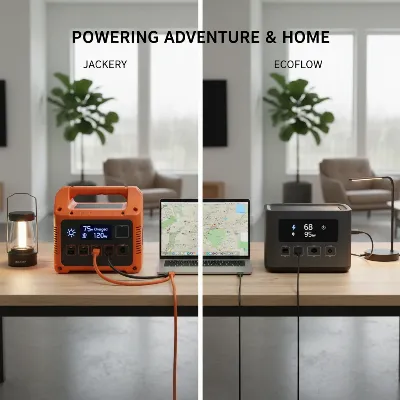 A Jackery portable power station (orange) and an EcoFlow portable power station (grey) side-by-side, both connected to charging cables and running small appliances.
Tips for Using and Maintaining Your Power Station
To ensure your portable power station serves you reliably for years, proper usage and maintenance are key.
Optimal Charging Practices
- Avoid Extreme Discharges: For LiFePO4 batteries, try to avoid regularly discharging below 20% or charging above 90% if you want to maximize the absolute number of charge cycles. While modern BMS systems protect against damage, maintaining a charge between 20-80% can extend battery health.
- Regular Use: Batteries perform best when used regularly. If storing for extended periods, charge the unit to around 50-60% capacity and recharge every 3-6 months.
- Use Original Chargers: Always use the manufacturer-provided AC adapters and solar panels for optimal charging efficiency and to prevent damage.
Storage and Environmental Care
- Cool, Dry Storage: Store your power station in a cool, dry, and well-ventilated area, away from direct sunlight, moisture, and extreme temperatures (both hot and cold). Optimal storage temperatures are typically between 0°C and 40°C (32°F and 104°F).
- Protect from Elements: While many units are rugged, avoid exposing them to heavy rain, dust, or sand without proper protection. If using solar panels, ensure they are set up to maximize sun exposure while protecting the power station itself.
- Physical Protection: When transporting, ensure the power station is secured to prevent impacts and vibrations. Consider a protective case if frequently moving the unit.
Regular Inspection and Cleaning
- Check Ports: Periodically inspect all input and output ports for dust, debris, or corrosion. Keep them clean to ensure efficient connections.
- Clean Vents: Ensure cooling vents are unobstructed to prevent overheating. Use a soft, dry cloth to wipe down the exterior.
- Firmware Updates: If your power station has smart features and an app, regularly check for firmware updates, which can improve performance, add features, and enhance safety.
“The future of portable power isn’t just about capacity, it’s about the seamless integration of speed, durability, and intelligent energy management. Both Jackery and EcoFlow are leading this charge, but your lifestyle will dictate which innovation truly serves you best.” – Dr. Alistair Finch, Renewable Energy Systems Engineer.
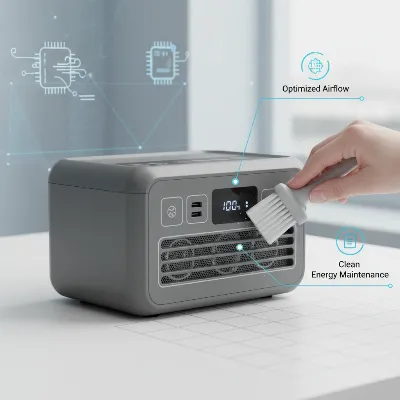 A person cleaning the vents of a portable power station with a soft brush, emphasizing proper maintenance for longevity.
Conclusion
The choice between Jackery and EcoFlow is a compelling one, with both brands offering robust, high-performance portable power stations designed to meet a myriad of needs. Jackery continues to impress with its renowned portability, user-friendliness, and rugged reliability, making it an excellent companion for casual adventurers, campers, and those seeking dependable, straightforward backup power. On the other hand, EcoFlow excels in cutting-edge innovation, boasting lightning-fast charging speeds, superior power output, and extensive expandability, which appeals to demanding off-grid users, RV enthusiasts, and individuals requiring scalable home backup solutions.
Ultimately, the best power station isn’t about which brand is inherently “superior,” but which one aligns most perfectly with your specific requirements, budget, and power-hungry lifestyle. By carefully considering factors like capacity, charging speed, battery chemistry, and intended use, you can confidently navigate the market and select the portable power station that empowers your adventures and safeguards your peace of mind. Which brand will illuminate your path forward?
Frequently Asked Questions
Frequently Asked Questions
Which battery type offers better longevity, LiFePO4 or NCM?
LiFePO4 (Lithium Iron Phosphate) batteries offer significantly better longevity, typically providing 3000-4000 charge cycles to 80% of their original capacity. This is compared to 500-800 cycles for older NCM (Lithium-ion) batteries, translating to a lifespan of 10+ years for LiFePO4 cells.
Can I use solar panels from one brand with a power station from another?
Generally, yes, but you may need an adapter to match the connectors (e.g., Jackery often uses an 8mm port, EcoFlow uses XT60). Always ensure the solar panel's voltage and wattage output are within the power station's acceptable input range to avoid damage and optimize charging efficiency.
How fast can EcoFlow power stations typically charge compared to Jackery?
EcoFlow power stations, particularly their DELTA series with X-Stream technology, are known for exceptionally fast AC charging, often going from 0-100% in about 60-75 minutes. Newer Jackery v2 models have improved, charging from 0-100% in approximately 1.3-2 hours, but EcoFlow generally maintains an edge in raw charging speed.
Are portable power stations safe to use indoors?
Yes, portable power stations are safe for indoor use as they operate silently and produce no toxic fumes, unlike gasoline generators. They are ideal for powering indoor appliances during outages without safety concerns related to emissions or carbon monoxide.
Can these power stations power a refrigerator during an outage?
Yes, most mid to high-capacity Jackery and EcoFlow power stations (e.g., Jackery Explorer 1000 v2/2000 v2, EcoFlow DELTA 2/3 series) can power a standard refrigerator for several hours to a full day. The duration depends on the fridge's wattage and the power station's capacity, so check specific model outputs.
How to Choose Between Jackery and EcoFlow Power Stations
Follow these steps to determine whether a Jackery or EcoFlow portable power station is best suited for your specific needs, considering factors like capacity, charging speed, and portability.
List all devices you plan to power, noting their wattage and required run time to calculate total Watt-hours (Wh). Consider your primary usage scenario, whether it's casual camping, extensive RVing, or home backup, and assess your portability requirements for the unit.
Scrutinize capacity (Wh), continuous power output (W), and battery type (prioritize LiFePO4 for longevity). Evaluate charging speed options, port availability for your devices, and whether expandability is a necessary feature for future power growth.
Consult independent reviews and user testimonials to gain real-world insights into performance and durability. Always purchase from reputable providers and verify the warranty duration (typically 3-5 years) and return policies to protect your investment.

I got a smaller Jackery unit, one of the 500-watt models, mainly for emergency backup during power outages. It works fine for charging phones and running a lamp, but I wish it had a bit more output for some of my smaller appliances. The LiFePO4 battery is a plus for longevity, though, knowing it’ll last for many cycles.
I’ve been using my EcoFlow Delta Pro for a few months now for my off-grid cabin, and it’s been a game-changer. The fast charging is no joke; I can top it up with solar panels way quicker than I expected. The expandability with extra batteries is also fantastic, letting me scale up my power as needed without buying a whole new unit. Definitely worth the investment for serious off-grid living.
My EcoFlow River Pro has been amazing for my van life setup. The higher power output compared to some other brands means I can run my blender and even a small induction cooktop without issues. It’s quiet and doesn’t produce any emissions, which is a huge improvement over the old gas generator I used to lug around. Recharging with my solar panels is seamless.
I went with a Jackery Explorer 1000 for weekend camping trips and it’s perfect for that. It’s super portable and feels really durable, exactly what I needed for tossing in the back of the truck. It handles my mini-fridge and charging all our devices with no problem. I appreciate the rugged design; it’s held up well to a few bumps and scrapes already.