In a world increasingly reliant on portable energy, the ability to generate your own power off-grid is not just a convenience—it’s a game-changer. Portable power stations offer incredible flexibility, keeping your essential devices running whether you’re camping under the stars, facing an emergency blackout, or simply working remotely outdoors. But what happens when your power station runs low and there’s no wall outlet in sight? The answer lies in the abundant, clean energy of the sun. This comprehensive guide will walk you through everything you need to know about setting up your own DIY solar charging system for your portable power station, empowering you to harness sustainable energy and stay powered up, wherever life takes you.
What is a Portable Power Station?
At its core, a portable power station is a robust, rechargeable battery housed in a compact unit, designed to provide AC (alternating current) and DC (direct current) power outlets for various electronic devices. Think of it as a super-sized power bank with household outlets. These stations typically incorporate lithium-ion or LiFePO4 batteries, an inverter to convert DC battery power to AC, and multiple output ports including USB-A, USB-C, 12V DC, and standard AC wall outlets. Many modern portable power stations also come with built-in solar charge controllers, simplifying the process of connecting them to solar panels. They are a popular choice for adventurers, emergency preparedness, and anyone seeking a quiet, emissions-free alternative to traditional generators.
Benefits of DIY Solar Charging for Portable Power Stations
Embracing a DIY approach to solar charging for your portable power station offers a multitude of advantages, extending beyond mere convenience.
Firstly, it grants you unparalleled energy independence. You’re no longer tied to the grid, giving you the freedom to explore remote locations or weather power outages with confidence. The sun’s energy is free and limitless, making it a sustainable choice that reduces your carbon footprint. Secondly, a DIY setup can be cost-effective in the long run. While initial investment is required for panels and accessories, the fuel source is perpetually free, unlike gasoline generators. Thirdly, it provides flexible and scalable power. You can start with a modest setup and expand your solar array as your energy needs grow. This modularity means you can tailor your system to specific scenarios, from a small panel for phone charging to multiple panels for powering larger appliances during extended trips. Lastly, solar charging is quiet and clean, operating without the noise, fumes, or maintenance headaches associated with traditional generators, making it ideal for serene environments or residential use.
Key Components for Your DIY Solar Charging Setup
To successfully charge your portable power station using solar power, you’ll need a few essential components working in harmony. Understanding each part is crucial for building an efficient and safe system.
Portable Power Station
The cornerstone of your setup is, of course, the portable power station itself. Before anything else, carefully review its specifications. You’ll need to identify:
- Maximum Solar Input Voltage (VOC) and Wattage: This dictates the type and number of solar panels you can connect. Exceeding these limits can permanently damage your power station.
- Input Connector Type: Common types include MC4, Anderson, and DC barrel jacks (often 8mm or 5.5mm). Your solar panel or adapter must match this.
- Built-in Charge Controller: Most modern power stations feature an integrated MPPT (Maximum Power Point Tracking) solar charge controller, which efficiently converts solar energy for battery storage. If your power station does not have one (common for older or very basic models), you’d need an external charge controller.
Solar Panels
These are the heart of your solar charging system, converting sunlight into electricity. They come in various types, each with pros and cons:
- Monocrystalline: Highly efficient, space-saving, and perform well in low light. Often more expensive.
- Polycrystalline: Less efficient than monocrystalline, but typically more affordable.
- Flexible: Lightweight, thin, and can be mounted on curved surfaces. Lower efficiency and durability.
- Foldable/Portable: Designed for easy transport and quick setup, ideal for camping and mobile use.
Consider the panel’s wattage, its Open Circuit Voltage (VOC), and its physical characteristics (rigid, foldable) based on your needs and your power station’s capabilities.
Charge Controller (If External)
If your portable power station doesn’t have a built-in solar charge controller, an external one is vital. Its role is to regulate the voltage and current from your solar panels, ensuring your power station’s battery charges safely and efficiently without overcharging or being damaged by fluctuating solar input.
- MPPT (Maximum Power Point Tracking): Recommended for most setups. MPPT controllers are highly efficient, especially in variable light conditions, by actively finding the optimal voltage and current at which solar panels produce maximum power.
- PWM (Pulse Width Modulation): A simpler, less expensive option, but also less efficient, particularly when panel voltage significantly differs from battery voltage.
Cables and Connectors
The right cables and connectors are essential for a secure and efficient connection.
- MC4 Connectors: Standard on most solar panels, these are weatherproof and secure.
- Anderson Connectors: Common on larger solar setups and some power stations, known for their quick-connect/disconnect functionality.
- DC Barrel Jacks: Typically found on smaller portable power stations (e.g., DC5521, 8mm).
- Adapters: You’ll often need MC4-to-Anderson or MC4-to-DC adapters to match your solar panel’s output to your power station’s input.
- Wire Gauge: Use appropriate gauge wires (e.g., 10AWG or 12AWG for solar extensions) to minimize voltage drop and prevent overheating, especially for longer cable runs.
Safety Devices (for more complex DIY builds)
While most portable power stations have built-in safety features, if you’re building a more extensive DIY system with separate batteries and inverters, you’d also consider:
- Fuse Protection: Crucial for protecting components from overcurrent.
- Battery Voltage Monitor: To keep an eye on battery health and charge status.
Comparing Solar Panel Types for DIY Charging
Choosing the right solar panel is key to the performance of your DIY charging setup. Here’s a comparison of common types:
| Panel Type | Description | Efficiency | Portability/Flexibility | Durability | Cost (Relative) | Ideal Use Case |
|---|---|---|---|---|---|---|
| Monocrystalline | Made from single crystal silicon, uniform dark appearance. | High (17-23%+) | Rigid, less portable | High | High | Permanent setups, maximizing power in limited space. |
| Polycrystalline | Made from multiple silicon crystals, bluish, checkered look. | Medium (15-17%) | Rigid, less portable | High | Medium | Budget-friendly fixed installations. |
| Flexible | Thin-film technology, can bend. | Low (10-14%) | High (lightweight, adaptable) | Medium | Medium-High | RV roofs, curved surfaces where weight and shape are critical. |
| Foldable/Portable | Typically monocrystalline panels hinged together. | High (17-22%) | Very High (easy to transport) | Medium-High | Medium-High | Camping, tailgating, emergency backup, mobile applications. |
For charging a portable power station, foldable/portable monocrystalline panels are often the best choice due to their balance of high efficiency, ease of transport, and straightforward setup. They come with integrated stands and often include a variety of connectors, making them ready for immediate use.
Step-by-Step Guide: Charging Your Portable Power Station with Solar DIY
Charging your portable power station with a DIY solar setup is a straightforward process when you know the steps.
Step 1: Assess Your Power Station’s Requirements
Before connecting anything, consult your power station’s manual or check the label near its input ports. Note down the following:
- Maximum input voltage (V) and wattage (W) it can handle from solar.
- Type of solar input connector (e.g., MC4, Anderson, 8mm DC barrel).
> “Always double-check your power station’s input specs. Exceeding the maximum voltage is a common and potentially costly mistake that can damage your unit’s internal components.” – Alex Chen, Portable Energy Systems Engineer
Step 2: Select Your Solar Panels
Based on your power station’s requirements from Step 1 and your intended use, choose your solar panels.
- Wattage: Aim for solar panels whose total wattage is close to, but does not exceed, your power station’s maximum solar input wattage.
- Voltage (VOC): Crucially, ensure the Open Circuit Voltage (VOC) of your solar panels (or combined VOC if connecting multiple panels in series) does not exceed your power station’s maximum input voltage.
- Type: Consider foldable monocrystalline panels for portability and efficiency.
Step 3: Gather Necessary Cables & Adapters
Ensure you have the correct cables and any required adapters.
- Most solar panels come with MC4 connectors. If your power station has a different input (e.g., 8mm DC barrel), you’ll need an MC4-to-DC adapter.
- If using multiple panels, you might need MC4 branch connectors for parallel wiring or MC4 extension cables.
- Verify the cables are of suitable gauge to minimize power loss.
Step 4: Position Your Solar Panels
Optimal placement is critical for maximum efficiency.
- Direct Sunlight: Lay your panels out in an area with full, unobstructed sunlight. Even a small shadow can significantly reduce output.
- Angle towards the Sun: Tilt your panels to face the sun directly. A 90-degree angle to the sun’s rays is ideal. Adjusting the angle and direction every few hours throughout the day can significantly increase energy harvest.
- Keep Cool: While panels need sun, try to keep your portable power station itself in the shade to prevent overheating, which can reduce charging efficiency and battery lifespan.
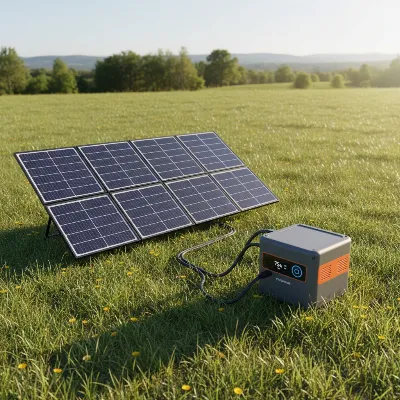 A portable power station being charged by foldable solar panels angled towards the sun in an outdoor setting
Step 5: Connect the System
Once positioned, make the connections:
- Connect Solar Panels: If using multiple panels, connect them in parallel (positive to positive, negative to negative) to maintain voltage while increasing current, which is generally safer for most portable power stations. (Connecting in series adds voltage, which can easily exceed your power station’s input limit).
- Connect to Power Station: Plug the output from your solar panels (or adapter) directly into the dedicated solar input port on your portable power station. Ensure connections are snug and secure.
Step 6: Monitor Charging
After connecting, power on your portable power station.
- Check Display: The display should show an input wattage or a charging indicator.
- Verify Input: A 200W panel in full sun might show 150-185W of actual input, accounting for efficiency losses. If you’re not seeing any input or it’s very low, recheck connections, panel positioning, and shading.
Optimizing Your Solar Charging Efficiency
Getting the most out of your DIY solar setup means understanding and applying a few key efficiency tips. Maximizing the watts your panels produce will lead to faster charging and a more reliable power supply.
Panel Angle Adjustment
The sun is a moving target. To maximize sunlight absorption, your solar panels should ideally be positioned at a 90-degree angle to the sun’s rays. This means:
- Avoid Lying Flat: Unless the sun is directly overhead, flat panels are less efficient.
- The “Three-Hour Rule”: If you’re stationary all day, try to adjust the tilt and direction of your panels every two to three hours. This simple action can increase your total daily energy harvest by up to 30%. Many portable solar panels come with adjustable kickstands for this purpose.
Shade Avoidance
Shade is the biggest enemy of solar panels. Even a small shadow on a portion of a panel can drastically reduce the output of the entire array.
- Micro-Shadows: Be mindful of shadows from tree branches, utility poles, or even thin power lines. These “micro-shadows” can act like a kink in a hose, significantly impacting power flow.
- Strategic Placement: Scout your location for areas that will remain shade-free throughout your charging window.
Keeping Components Cool
Surprisingly, heat can hinder electrical efficiency.
- Panels: As solar cells get hot, their voltage drops. While you can’t stop the sun from heating them, ensuring good airflow around rigid panels can help.
- Power Station: The lithium batteries inside struggle to charge efficiently when baking in the sun. Use the length of your solar cables to keep your panels in the sun while keeping the power station unit itself in the shade or under your vehicle. Never leave it charging inside a hot, sealed car.
Cable Quality and Length
Electricity loses power (voltage drop) as it travels through a wire, especially over longer distances or through thin cables.
- Keep it Short: Use only as much cable length as you need to reach the sun.
- Check the Gauge: If you must use an extension, ensure it’s a high-quality, thick-gauge solar cable (e.g., 10AWG or 12AWG) to minimize resistance and voltage drop. Undersized wires can lead to significant power loss and even pose a fire risk.
Regular Cleaning
A layer of dust, pollen, leaves, or salt spray on your solar panels acts like a permanent thin shadow, reducing efficiency.
- Wipe Down: Keep a microfiber cloth in your kit and give the panels a quick wipe-down regularly, especially before a charging session.
- Mild Detergent: For stubborn grime, a mild detergent solution can be used, ensuring it’s completely rinsed off.
Safety Precautions for DIY Solar Charging
While charging a portable power station with solar panels is generally safe, particularly with units that have built-in charge controllers, a DIY approach still requires adherence to safety guidelines, especially if you’re assembling a system from individual components.
Voltage Limits
Never exceed the maximum input voltage (VOC) specified by your portable power station or external charge controller. Overvoltage can cause irreversible damage to the internal electronics. Always check the panel’s VOC against your device’s limits.
Correct Wiring and Connections
- Polarity: Ensure correct positive (+) and negative (-) polarity when connecting components. Incorrect polarity can cause shorts or damage.
- Secure Connections: All connections (MC4, Anderson, DC barrel) should be snug and secure to prevent arcing and power loss.
- Series vs. Parallel: When connecting multiple solar panels, parallel wiring (connecting positives together and negatives together) increases current but keeps voltage the same, which is generally safer for portable power stations. Series wiring (connecting positive of one panel to negative of the next) adds voltages, which can quickly exceed limits.
Fuse Protection
For any DIY solar setup involving separate batteries, charge controllers, and inverters, adequate fuse protection on both the DC and AC sides of the system is paramount. Fuses protect against overcurrent, preventing damage and fire hazards.
Proper Grounding (for advanced DIY systems)
If you are building a more extensive, stationary DIY solar generator that includes an inverter and potentially AC wiring, proper equipment grounding is critical. This ensures that in case of an electrical fault, current has a safe path to the earth, tripping breakers and preventing electrocution. This is less common for simple portable power station charging but vital for larger home-built systems.
Lockout-Tagout-Verify (for advanced DIY systems)
When working on more complex DIY solar circuits, especially those with high voltages, always follow a “lockout-tagout-verify” procedure:
- Turn Off: Disconnect all power sources (cover solar panels, open breakers).
- Tag It: Mark switches/breakers to prevent accidental re-energization.
- Test It: Use a multimeter to confirm zero voltage before touching any wires.
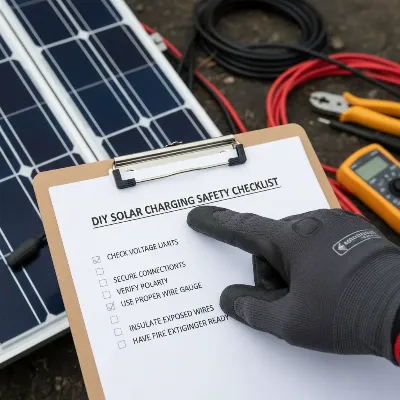 A hand checking a safety checklist for a DIY solar charging setup, with clear labels for safe practices
Tips for Using and Maintaining Your Portable Power Station & Solar Setup
Proper usage and regular maintenance will significantly extend the lifespan and reliability of both your portable power station and its solar charging components.
Battery Health
The battery is the most critical component of your power station.
- Avoid Deep Discharges: While LiFePO4 batteries are robust, consistently draining any battery to 0% can shorten its overall lifespan. Aim to recharge before it hits critically low levels.
- Moderate Charge for Storage: If storing your power station for an extended period, try to keep it charged to around 50-80% of its capacity, and recharge it every few months. This “storage charge” helps preserve battery health.
- Temperature: Store your power station in a cool, dry place. Extreme heat or cold can degrade battery performance and life.
Regular System Checks
Periodically inspect your entire solar charging setup.
- Cables and Connectors: Look for any signs of wear, fraying, or corrosion on cables and connectors. Replace damaged components immediately.
- Panel Surface: Ensure the solar panels are free from cracks or damage.
- Input Readings: Pay attention to your power station’s input readings. A sudden drop in wattage might indicate an issue with panel placement, shading, or a component failure.
Storage
- Solar Panels: When not in use, fold and store your portable solar panels in their designated bag or a protected area to prevent physical damage.
- Power Station: Store the power station in a cool, dry, well-ventilated area, away from direct sunlight, moisture, and flammable materials.
By following these tips, you’ll ensure your DIY solar charging setup remains a dependable source of clean, portable power for years to come.
Conclusion
Harnessing the sun to power your portable devices is a liberating and eco-conscious choice, offering energy independence wherever your adventures take you. By understanding the core components, carefully setting up your system, and following essential safety and efficiency guidelines, you can reliably charge your portable power station with DIY solar panels. This empowers you to stay connected, keep essentials running, and embrace off-grid living with confidence. With the right knowledge and a little preparation, the vast energy of the sun becomes your personal power source.
Are you ready to unlock the full potential of your portable power station with the boundless energy of the sun?
Frequently Asked Questions
How long does it take to charge a portable power station with solar panels?
Charging time varies significantly based on your solar panel’s wattage, the power station’s capacity, and sunlight conditions. A 200W panel might charge a 1000Wh power station in about 5-8 hours of optimal sunlight, but factors like shade, panel angle, and weather can extend this.
Can I connect any solar panel to any portable power station?
No, compatibility is crucial. You must match the solar panel’s open circuit voltage (VOC) and total wattage to your power station’s maximum solar input voltage and wattage. The connector types must also be compatible, possibly requiring adapters.
Do I need a charge controller for DIY solar charging?
Most modern portable power stations have a built-in MPPT (Maximum Power Point Tracking) solar charge controller, making direct connection simple. If your power station does not have one, an external MPPT charge controller is essential to regulate voltage and prevent overcharging, especially for systems with separate batteries.
What’s the best angle for my solar panels?
For maximum efficiency, solar panels should be positioned at a 90-degree angle to the sun’s rays. This often means tilting them and adjusting their direction every few hours as the sun moves across the sky to optimize energy capture.
Can shade really impact solar charging efficiency that much?
Yes, even partial shading on a single solar panel can drastically reduce the overall power output of your entire solar array. Most panels are wired in series, so a shaded cell can act as a bottleneck, significantly lowering the current for the whole system.
