In a world where portable power has become essential for everything from outdoor adventures to emergency preparedness, knowing how long your power station can keep your devices running is crucial. Whether you’re planning a camping trip, preparing for an outage, or simply want to understand your energy independence, calculating your power station’s runtime is a fundamental skill. Without this knowledge, you might find yourself in the dark sooner than expected, underscoring the importance of understanding the intricate relationship between battery capacity, device power draw, and efficiency. This guide will demystify the process, providing you with a clear, step-by-step approach to accurately predict how long your power station will last.
Understanding the Basics: Watts vs. Watt-Hours
Before diving into calculations, it’s vital to grasp the difference between two key electrical terms: watts and watt-hours. These units measure distinct aspects of electricity and are both crucial for estimating your power station’s performance.
What is a Watt (W)?
|
Our Picks for the Best Power Station in 2026
As an Amazon Associate I earn from qualifying purchases.
|
||
| Num | Product | Action |
|---|---|---|
| 1 | Anker SOLIX C300 Portable Power Station with Car Charging Cable, Outdoor 288Wh LiFePO4 Battery, 300W (600W Surge) Solar Generator, 140W Two-Way Fast Charging, for Camping, Traveling, and Emergencies. |

|
| 2 | Anker SOLIX C1000 Gen 2 Portable Power Station, 2,000W (Peak 3,000W) Solar Generator, Full Charge in 49 Min, 1,024Wh LiFePO4 Battery for Home Backup, Power Outages, and Camping (Optional Solar Panel) |
|
| 3 | Jackery Explorer 2000 v2 Portable Power Station with 2x200W Solar Panels, 2042Wh LiFePo4 Battery, 2200W Solar Generator, 20ms UPS, USB-C PD 100W Fast Charging for Power Outages, Emergencies, Camping |
|
| 4 | Anker SOLIX C1000 Portable Power Station, 1800W (Peak 2400W) Solar Generator, Full Charge in 58 Min, 1056wh LiFePO4 Battery for Home Backup, Power Outages, and Outdoor Camping (Optional Solar Panel) |
|
| 5 | BLUETTI Portable Power Station AC180, 1152Wh LiFePO4 Battery Backup w/ 2 1800W (2700W peak) AC Outlets, 0-80% in 45Min, Solar Generator for Camping, Off-grid, Power Outage |
|
| 6 | Westinghouse 155Wh 150 Peak Watt Portable Power Station & Solar Generator, Modified Sine Wave AC Outlet, Backup Lithium Battery for Camping, Home, Travel, Indoor/Outdoor Use (Solar Panel Not Included) |
|
| 7 | 550W Portable Power Inverter Compatible with Dewalt 20V Battery, Power Station DC 20V to AC 110V Pure Sine Wave, Battery Power Adapter 2USB&Type-C, Generator Phone Charger LED Light Camping Emergency |
|
| 8 | 550W Power Station Compatible with Dewalt: LIVOWALNY Portable Generator DC 20V to AC 110-120V, Pure Sine Wave Power Inverter Battery Adapter Phone Charger 2 USB-A & 1 Type-C & 2 AC Outlet (Tool Only) |
|
| 9 | Anker SOLIX F3800 Portable Power Station, 3840Wh, LiFePO4 Batteries, Ultra-High 6000W AC Output with 120V/240V, Solar Generator for Home Backup, RVs, Emergencies, Power Outages, and Outdoor Camping |
|
| 10 | UGREEN Power Strip Surge Protector with 4 Power Outlets, 15w Wireless Charger, 20W PD3.0 USB C Fast Charging, 2 USB-C Ports, 2 USB A Ports, Desk Charging Station for Office, Conference, Home Use |
|
A watt (W) is a unit of power, representing the rate at which electrical energy is consumed or produced at a specific moment. Think of watts as the “speed” of electricity flowing to your device. For instance, a 60-watt light bulb uses 60 watts of power at any given instant it is on. Devices with higher wattage ratings, such as hair dryers or microwaves, consume power much faster than lower-wattage items like phone chargers or LED lights. Knowing a device’s wattage is the first step in determining its energy demands.
What is a Watt-hour (Wh)?
A watt-hour (Wh), on the other hand, is a unit of energy that measures the total amount of electrical energy consumed or stored over a period of time, typically one hour. If watts represent speed, watt-hours represent the “distance traveled” or the total “fuel” available. For example, a power station with a 1000Wh capacity can theoretically supply 1000 watts for one hour, or 100 watts for ten hours. This figure is the most critical specification when assessing how much energy a power station can store and deliver before needing a recharge.
Why Both Are Crucial
Watts tell you how much power a device needs to operate, while watt-hours tell you how much total energy your power station can provide. To calculate runtime, you need both: the total energy available (Wh) and the rate at which it’s being consumed (W). Understanding this distinction is the bedrock of accurately predicting your power station’s endurance.
The Core Formula for Power Station Runtime
Calculating how long your portable power station will power your devices is a straightforward process once you have the right information. The fundamental formula factors in the power station’s capacity, the total power draw of your connected devices, and an efficiency factor that accounts for energy losses.
The general formula is:
Runtime (hours) = (Battery Capacity (Wh) × Efficiency Factor) ÷ Total Device Load (W)
Let’s break down each component of this essential calculation.
Battery Capacity (Wh)
This is the total energy storage capacity of your power station, almost always listed in watt-hours (Wh) on the product’s specifications or label. It signifies the maximum amount of energy your unit can hold. A higher Wh rating means more stored energy and, consequently, a longer potential runtime for your devices.
Total Device Load (W)
This refers to the combined power consumption of all devices you intend to run simultaneously. Each electronic device has a wattage rating, usually found on its label, in its manual, or on the manufacturer’s website. If you plan to power multiple devices, simply add up their individual wattage ratings to get your total device load. For example, if you’re running a 60W laptop and a 10W LED lamp, your total load would be 70W.
Efficiency Factor
The efficiency factor is a critical but often overlooked component. Portable power stations convert the stored DC (direct current) battery power into AC (alternating current) power for most household appliances, or regulate it for USB and DC outputs. This conversion process, particularly the AC inverter, is not 100% efficient, meaning some energy is lost as heat.
Most high-quality portable power stations, especially those with pure sine wave inverters, operate with an efficiency of around 85% to 90%. Therefore, a common and safe efficiency factor to use in your calculations is 0.85. This accounts for approximately 15% energy loss during the conversion process, providing a more realistic runtime estimate. Using an efficiency factor ensures your calculations reflect real-world performance rather than theoretical maximums.
Step-by-Step Calculation Guide
Let’s walk through an example to illustrate how to calculate your power station’s runtime using the formula.
Step 1: Determine Your Power Station’s Capacity (Wh)
Locate the watt-hour (Wh) rating on your portable power station. This is typically printed on a label on the unit itself, in the user manual, or on the manufacturer’s website. For this example, let’s assume your power station has a capacity of 1000Wh.
Step 2: Identify Device Wattage (W)
List all the devices you plan to power and find their individual wattage ratings. This information is usually on the device’s power adapter, label, or in its manual. If you’re running multiple devices, sum their wattages to get the “Total Device Load.”
- Laptop: 60W
- LED Lamp: 10W
- Small Fan: 30W
Total Device Load = 60W + 10W + 30W = 100W
If you want to be precise, consider investing in a watt meter (also known as a kill-a-watt meter) to measure the actual power draw of your devices, as listed wattages can sometimes be maximums rather than typical operating consumption.
Step 3: Account for Inverter Efficiency
Apply the efficiency factor to your power station’s capacity. As discussed, a common and realistic efficiency factor is 0.85 (85%).
Usable Capacity = Battery Capacity (Wh) × Efficiency Factor
Usable Capacity = 1000Wh × 0.85 = 850Wh
This means that out of your 1000Wh capacity, approximately 850Wh is actually usable power delivered to your devices due to conversion losses.
Step 4: Perform the Calculation with an Example
Now, plug these values into the runtime formula:
Runtime (hours) = Usable Capacity (Wh) ÷ Total Device Load (W)
Runtime (hours) = 850Wh ÷ 100W = 8.5 hours
Based on this calculation, your 1000Wh power station, running the laptop, LED lamp, and small fan simultaneously (100W total load), would last for approximately 8.5 hours. This method provides a realistic estimate, empowering you to plan your power usage effectively.
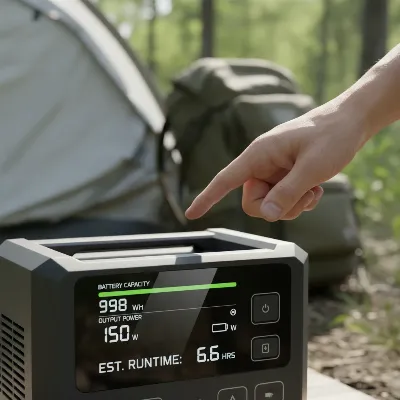 Portable Power Station runtime calculation with a digital display showing wattage and battery life.
Factors That Influence Actual Runtime
While the calculation provides a strong estimate, several real-world factors can influence the actual runtime of your portable power station. Understanding these variables can help you better manage your expectations and optimize usage.
Device Power Consumption
The most significant factor is the actual power draw of your connected devices. High-wattage appliances, like electric kettles or mini-fridges, will drain the battery much faster than low-wattage items such as smartphones or LED lights. Devices that cycle on and off (like refrigerators) will have an intermittent power draw, making precise runtime prediction more complex. Always verify the running wattage of your devices for the most accurate calculation.
Inverter Efficiency
As highlighted in the calculation, the efficiency of your power station’s inverter (which converts DC to AC power) directly impacts usable energy. Cheaper or less advanced inverters might have lower efficiency, meaning a larger percentage of your stored energy is lost as heat. Opting for power stations with high-efficiency pure sine wave inverters generally leads to better runtime performance and safer operation for sensitive electronics.
Temperature and Environmental Conditions
Extreme temperatures can significantly affect battery performance. In very cold conditions, battery capacity can temporarily decrease, leading to shorter runtimes. Conversely, high temperatures can accelerate battery degradation over time, reducing its overall lifespan and potentially its immediate efficiency. For optimal performance, it’s best to operate and store your power station within its recommended temperature range, typically between 32°F and 104°F (0°C to 40°C).
Battery Age and Health
Like all batteries, those in portable power stations degrade over time. After a certain number of charge-discharge cycles (e.g., 500-1000 for standard lithium-ion, 2000-7000+ for LiFePO4), a battery’s total capacity will begin to diminish, typically to about 80% of its original rating. An older battery, or one that has been improperly maintained, will naturally provide shorter runtimes than a new, healthy one, even with the same calculated load.
Depth of Discharge (DoD)
Regularly draining your power station’s battery to 0% (deep discharge) can accelerate its degradation and shorten its overall lifespan. Many manufacturers and battery experts recommend keeping the charge level between 20% and 80% for optimal battery health and longevity. While the calculation assumes full capacity, frequently operating outside this recommended range can lead to a perceived shorter runtime over the long term.
Maximizing Your Power Station’s Runtime and Lifespan
Extending the usable runtime of your portable power station and ensuring its longevity involves a combination of smart usage habits and proper care. By implementing a few key strategies, you can get the most out of your investment.
Choose Energy-Efficient Devices
One of the most effective ways to maximize runtime is to power devices that consume less energy. Opt for LED lighting over incandescent bulbs, use energy-efficient laptops, and choose appliances specifically designed for low power consumption, especially when off-grid. Every watt saved directly translates to longer hours of operation from your power station.
Optimize Usage Habits
Avoid habitually draining your power station to 0% or charging it to 100% and leaving it there for extended periods. Instead, aim to keep the battery charge between 20% and 80% whenever possible. This “sweet spot” minimizes stress on the battery cells, significantly extending their cycle life and overall lifespan. If you only need a small amount of power, don’t fully charge the station if it’s not necessary.
“To truly extend the life of your power station’s battery, think of it like a muscle: consistent, moderate use within its optimal range is far better than repeated strenuous extremes. The 20-80% rule is your best friend for long-term health.” – Dr. Elena Petrova, Lead Battery Scientist
Proper Storage Conditions
Store your power station in a cool, dry place, away from direct sunlight and extreme temperatures. High heat can accelerate battery degradation, while extreme cold can temporarily reduce performance. If storing for an extended period, ensure the battery is charged to around 50-60%. This state of charge is ideal for long-term dormancy, minimizing self-discharge and preserving cell integrity.
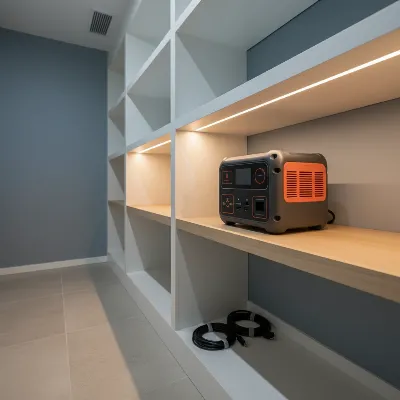 Portable Power Station stored safely indoors with ideal conditions
Regular Maintenance
Keep your power station clean, especially its ventilation ports, to prevent dust and debris from accumulating and obstructing airflow. Good airflow is essential for dissipating heat generated during operation, which in turn helps maintain efficiency and battery health. Additionally, ensure you use the correct charger provided by the manufacturer to avoid potential damage from incompatible voltage or current. Some modern power stations also offer firmware updates, which can improve battery management and efficiency—keep these updated if available.
Conclusion
Understanding how to calculate your portable power station’s runtime is more than just a technical exercise; it’s about empowering yourself with reliable energy knowledge. By grasping the clear distinction between watts and watt-hours, employing the core runtime formula with an appropriate efficiency factor, and proactively managing your device’s power consumption, you gain precise control over your energy needs. While factors like temperature and battery age will always play a role, a methodical approach to calculation and smart usage habits ensures you can confidently estimate and maximize your power station’s performance.
Now that you’re equipped with this knowledge, what will be the first essential calculation you make for your next adventure or emergency preparedness plan?
Frequently Asked Questions
What is a safe efficiency factor to use in calculations?
A safe and commonly accepted efficiency factor for most modern portable power stations, especially those with pure sine wave inverters, is 0.85 (or 85%). This accounts for typical energy losses during the DC-to-AC conversion process and provides a realistic estimate.
How can I accurately measure a device’s wattage?
The most accurate way to measure a device’s real-time wattage is by using a watt meter (also known as a kill-a-watt meter). You plug the device into the meter, and the meter then plugs into a standard wall outlet (or directly into your power station for testing), displaying the actual power consumption in watts.
Does charging the power station while using it affect runtime?
Yes, charging a power station while simultaneously powering devices (passthrough charging) affects its net runtime. If the input charge rate is higher than the total device load, the battery will continue to charge. If the load is higher, the battery will still drain, but at a slower rate than if it weren’t charging.
Can I run multiple devices at once?
Absolutely. Portable power stations are designed to run multiple devices simultaneously, provided their combined wattage does not exceed the power station’s continuous output rating. To calculate runtime for multiple devices, sum their individual wattages to get the “Total Device Load” for the runtime formula.
What is the difference between peak and continuous wattage?
Continuous wattage (or running watts) is the maximum power a power station can safely provide for an extended period. Peak wattage (or surge watts) is the higher, short burst of power it can provide for a few seconds to start motors or other inductive loads. Always ensure your devices’ continuous wattage is within the Power Station’s continuous rating, and consider surge needs for specific appliances.