In an era where reliable power is no longer a luxury but a necessity, the humble portable power station has evolved into a sophisticated, scalable energy solution. Whether you’re navigating unexpected power outages at home, venturing into the great outdoors, or seeking energy independence, the demand for versatile power sources has never been higher. For many, the answer lies in expandable battery power stations – units designed not just for immediate needs but also for future growth and extended utility.
These innovative devices offer unparalleled flexibility, allowing you to scale your power reserves precisely as your requirements change. No longer are you tied to a fixed capacity; instead, you can tailor your energy storage to fit a weekend camping trip, an extensive RV adventure, or even a robust home backup system. This comprehensive guide will explore the world of expandable power stations, outlining what they are, their significant benefits, crucial factors to consider when buying, and highlight the top models available in 2026 to help you make the smartest choice for your energy needs.
Power Station: A Comprehensive Portable Energy Solution
At its core, a portable power station is a rechargeable, battery-powered generator that provides electricity without needing gasoline or producing fumes. Think of it as a go-anywhere wall outlet, storing energy in its battery pack and converting it into usable power for various devices. An expandable power station takes this concept further by offering a modular design, enabling users to significantly increase the overall battery capacity by connecting additional battery packs. This means your initial investment isn’t rigid; you can start with a base unit and add more storage as your energy demands grow. For best portable power roundups on this site.
These systems comprise several key components working in harmony. The battery is the heart of the system, typically made from advanced lithium-ion (Li-ion) or Lithium Iron Phosphate (LiFePO4) chemistries. LiFePO4 batteries are increasingly preferred for their longer lifespan, enhanced safety, and greater number of charge cycles. An inverter converts the stored DC power from the battery into AC power, which most household electronics and appliances require. A crucial Battery Management System (BMS) constantly monitors and protects the battery from overcharging, short circuits, and overheating, ensuring both the power station and your connected devices remain safe. Lastly, multiple input/output ports – including AC outlets, USB-A, USB-C, and DC car ports – allow for versatile connectivity.
Benefits of Using Expandable Power Stations
The advantages of opting for a power station with expandable batteries are numerous and compelling, addressing a wide spectrum of energy needs.
First and foremost is scalability and flexibility. Unlike traditional fixed-capacity power stations, expandable models allow you to adapt your power source to evolving demands. You can begin with a smaller unit for light camping trips and then add extra battery packs for longer excursions, remote work setups, or substantial home backup during outages. This modularity means you only buy the capacity you need when you need it, optimizing your investment over time.
This directly leads to extended runtime. By increasing the battery capacity, you can significantly prolong the operational time of your devices and appliances, ensuring continuous power during prolonged blackouts or extended periods off-grid. For critical applications like medical devices, refrigeration, or essential communication, this extended duration can be invaluable.
Expandable power stations champion clean, quiet, and fume-free operation. Unlike noisy, fuel-guzzling gas generators that release harmful emissions, these battery-powered units operate silently and produce zero fumes. This makes them perfectly safe for indoor use, whether in an apartment, a tent, or a workshop, without the need for ventilation.
 Family enjoying outdoor activities with an expandable portable power station
Versatility extends to charging options. Most expandable power stations can be recharged from standard AC wall outlets for rapid turnaround, through solar panels for sustainable energy generation, or via a car’s 12V adapter while on the move. This multi-source charging capability ensures you can replenish your power reserves almost anywhere. Many models also feature advanced fast-charging technologies, significantly reducing downtime.
Furthermore, the prevalence of LiFePO4 battery chemistry in modern expandable power stations translates to a much longer lifespan and enhanced durability. These batteries offer thousands of charge cycles, far surpassing older lithium-ion variants, providing years of reliable service and better value over the product’s lifetime. Their improved thermal stability also contributes to overall safety.
Ultimately, choosing an expandable power station means investing in a future-proof energy solution that grows with you, offers peace of mind through reliable backup, and supports a cleaner, quieter, more flexible power experience.
Key Factors to Consider When Choosing an Expandable Power Station
Selecting the ideal expandable power station requires careful consideration of several technical specifications and practical features. Understanding these factors will ensure your investment aligns perfectly with your power needs.
Capacity (Watt-hours/Kilowatt-hours): This is perhaps the most critical factor, indicating how much energy the power station can store. It determines how long your devices can run. To assess your needs, list all the devices you plan to power simultaneously, find their wattage (W), and estimate their usage duration. For example, a 1000Wh unit can power a 60W laptop for over 16 hours. For home backup, consider your daily essential power consumption (e.g., refrigerator, lights, router). Expandable systems are particularly advantageous here, as you can start with a base capacity and add units to reach higher kWh figures.
Output Power (Watts): This refers to the maximum power the station can deliver at any given moment. You’ll see two ratings: continuous output and surge output. Continuous output is what the unit can sustain, while surge output is a higher peak it can handle for a few seconds (crucial for appliances with motors like refrigerators or power tools that demand extra power on startup). Ensure the continuous output meets or exceeds the combined wattage of all devices you intend to run simultaneously.
Battery Chemistry and Lifespan: As mentioned, LiFePO4 (Lithium Iron Phosphate) batteries are a superior choice for expandable power stations. They offer a significantly longer cycle life (3,000 to 4,000+ cycles to 80% capacity) compared to traditional Lithium-ion (NCM) batteries (500-800 cycles). LiFePO4 also boasts better thermal stability and safety. While Li-ion might be slightly lighter, the longevity and safety benefits of LiFePO4 often outweigh this for expandable systems designed for long-term use.
Number and Type of Output Ports: A versatile power station will feature a variety of ports. Look for multiple AC outlets (standard wall plugs), DC ports (12V car ports for car fridges or other DC appliances), and a generous selection of USB ports (USB-A and fast-charging USB-C PD ports). Some advanced models even offer wireless charging pads or specialized ports like 240V or EV charging. The more variety, the more devices you can power without adapters.
Recharge Speed and Options: How quickly and by what means can you recharge the power station? Fast AC wall charging is a major convenience, with some units reaching 80% in under an hour. Solar charging compatibility is essential for off-grid use and eco-friendly power, so check the maximum solar input wattage. Car charging provides flexibility on the road. The more charging methods available, the more adaptable your power station will be.
Portability and Design: Consider the physical size and weight of the base unit and its expansion batteries. While smaller expandable units might be genuinely portable for hiking, larger systems designed for home backup often incorporate wheels and telescopic handles for easier movement despite their substantial weight. A robust, durable build is also important, especially for outdoor use.
Safety Features: A reliable power station will integrate advanced safety features. Look for a robust Battery Management System (BMS) that offers protection against overcharging, over-discharging, over-current, short-circuiting, and extreme temperatures. Certifications from reputable safety organizations also indicate adherence to high safety standards.
Expandability Mechanism: How easy is it to add and remove extra battery packs? Is it a simple plug-and-play system, or does it require more complex wiring? What is the maximum capacity you can achieve with additional batteries? Understanding the seamlessness of expansion is key to leveraging this feature.
Smart Features and App Control: Many modern power stations come with companion smartphone apps that allow you to monitor battery levels, input/output wattage, control charging modes, and even manage settings remotely. Integrated displays on the unit itself provide essential information at a glance. These smart features enhance user experience and control.
By meticulously evaluating these factors, you can confidently choose an expandable power station that not only meets your current demands but also provides the flexibility to power your future adventures and needs.
Top Expandable Power Stations in 2026: A Detailed Comparison
The market for portable power stations with expandable batteries is robust, with several leading brands offering impressive solutions in 2026. Here’s a closer look at some of the most popular and highly-rated options.
EcoFlow Delta Series
EcoFlow has consistently been a frontrunner in the portable power industry, known for its rapid charging speeds and innovative designs. Their Delta series, in particular, offers a range of expandable options suitable for various needs.
- EcoFlow Delta Pro Ultra: Positioned as a whole-home backup solution, the Delta Pro Ultra is an extremely versatile option. Starting with a substantial 6 kWh capacity, it can be expanded up to a massive 30 kWh with additional battery packs. If you connect multiple units, the total capacity can reach an astounding 90 kWh. It boasts an impressive 7,200W output, capable of powering a three-ton central air conditioner. Its modular design allows for portability, meaning you can disconnect parts for on-the-go use. The EcoFlow app provides comprehensive control and monitoring.
- EcoFlow Delta 3 Ultra Plus: A high-capacity option for serious off-grid needs, the Delta 3 Ultra Plus offers a 3,072Wh base capacity, expandable up to a huge 11,000Wh. Its output ranges from 3,600W to 7,200W, making it suitable for appliances and power tools. It also features fast charging.
- EcoFlow Delta 3 Plus: This model strikes an excellent balance between portability and power. With a built-in 1,024Wh battery, it can expand up to 5,000Wh with an extra battery pack. It offers an 1,800W output (3,600W surge) and boasts an impressive recharge time of under an hour. Users praise its quiet operation and wide selection of ports, including fast-charging USB-C. While not ideal for whole-home backup, it excels for longer trips or general household needs.
- EcoFlow Delta 2: An excellent entry into expandable power, the Delta 2 base unit can expand up to 3kWh. It’s noted for having many ports (15 total) and a competitive price.
EcoFlow products are generally praised for their high quality, ease of use, reliability, and robust app integration.
Anker SOLIX Series
Anker, a well-established name in charging technology, has made significant strides in the portable power station market with its SOLIX series, focusing on durable builds and ultra-fast charging.
- Anker SOLIX F3800 Plus: Designed with home backup in mind, this powerhouse starts with a 3,840Wh capacity and is expandable up to an enormous 26.9kWh. It delivers a substantial 6,000W output (9,000W surge) and includes unique features like a 240V port and an EV charging port, making it incredibly versatile. Despite its heavy weight, integrated wheels and a pull handle enhance its portability for temporary use. Its intuitive app and on-unit controls simplify operation.
- Anker SOLIX C1000 Gen 2: This highly portable unit features a 1,024Wh base battery, which can be expanded to 2,112Wh with one additional battery. Its standout feature is its ultra-fast recharging capability, fully charging its battery in just 49 minutes. The C1000 Gen 2 offers a 2,000W output (2,500W surge) and is praised for its compact size, robust design, and excellent performance for camping and job site tasks. While its expansion is limited to a single extra battery, its speed and portability make it a favorite for many.
Anker Solix units are often highlighted for their thoughtful design, user-friendly aesthetics, and strong performance-to-size ratio.
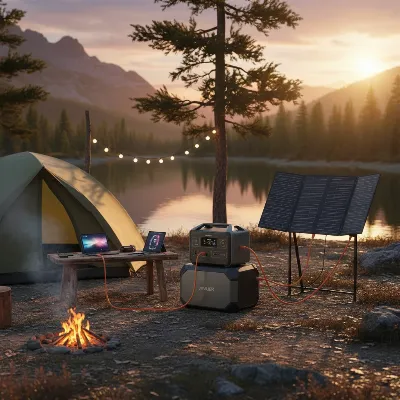 Anker Solix C1000 Gen 2 power station being used at a campsite with solar panels
Jackery Explorer Plus Series
Jackery has built a reputation for reliable and durable portable power solutions, and their Plus series exemplifies their commitment to expandable capabilities and long-lasting performance.
- Jackery Explorer 2000 Plus: This heavy-duty option boasts a 2,000Wh base capacity, which can be expanded up to a whopping 24kWh with multiple battery packs (up to five). It offers a powerful 3,000W output (6,000W peak) and utilizes durable LiFePO4 batteries designed for 3,000 to 4,000 charge cycles, a significant increase over many competitors. Its built-in wheels and telescopic handle make it manageable despite its combined weight when expanded, making it a strong contender for home backup and extended off-grid adventures.
- Jackery Explorer 1000 Plus: A more portable yet powerful option, the Explorer 1000 Plus features a 1,264Wh internal battery and can expand up to 5,000Wh by adding up to three additional batteries. Weighing around 32 pounds, it remains genuinely portable and suitable for camping or remote work. It is equipped with a 2,000W pure sine wave inverter, capable of handling most power needs. The Jackery Smart App works well for monitoring and control, and it pairs efficiently with Jackery’s SolarSaga panels.
Jackery power stations are recognized for their sturdy build quality, intuitive operation, and reliable performance, often serving as a gateway for many into the portable power world.
Here’s a quick comparison table of these top models:
| Model | Base Capacity (Wh) | Max Expandable Capacity (Wh/kWh) | Output (W) (Continuous/Peak) | Battery Type | Key Feature |
|---|---|---|---|---|---|
| EcoFlow Delta Pro Ultra | 6,000 | 90,000 (90 kWh) | 7,200 | LiFePO4 | Extreme home backup scalability |
| EcoFlow Delta 3 Ultra Plus | 3,072 | 11,000 (11 kWh) | 3,600-7,200 | LiFePO4 | High capacity for extensive off-grid |
| EcoFlow Delta 3 Plus | 1,024 | 5,000 (5 kWh) | 1,800/3,600 | LiFePO4 | Fast charging, versatile mid-range |
| Anker SOLIX F3800 Plus | 3,840 | 26,900 (26.9 kWh) | 6,000/9,000 | LiFePO4 | Home backup, EV charging, wheeled |
| Anker SOLIX C1000 Gen 2 | 1,024 | 2,112 (2.1 kWh) | 2,000/2,500 | LiFePO4 | Ultra-fast 49-minute recharge, portable |
| Jackery Explorer 2000 Plus | 2,000 | 24,000 (24 kWh) | 3,000/6,000 | LiFePO4 | High cycle life, wheeled for mobility |
| Jackery Explorer 1000 Plus | 1,264 | 5,000 (5 kWh) | 2,000 | LiFePO4 | Portable, robust for remote work/camping |
Buying Guide: How to Select Your Ideal Expandable Power Station
Choosing the perfect expandable power station might seem daunting with the array of options available. By following a structured approach, you can narrow down your choices and make an informed decision.
Step 1: Assess Your Specific Power Needs. Begin by identifying why you need a power station. Is it primarily for short camping trips, extended RV living, emergency home backup, or powering tools on a remote job site? List all the devices and appliances you plan to use, their individual wattages, and the approximate duration you expect to run them. This exercise will help you calculate your total watt-hour (Wh) requirements and necessary continuous/surge output. For instance, a small refrigerator (60-120W) running for 8 hours would need 480-960Wh. Always add a 20% buffer for safety and efficiency.
Step 2: Match Capacity and Output to Your Assessment. Based on your calculated needs, look for a base power station whose capacity and output ratings meet or ideally exceed your peak requirements. For expandable systems, consider the maximum capacity you might need in the future. If you foresee requiring significant power for extended periods, prioritize models that can expand into the multi-kilowatt-hour range.
Step 3: Prioritize Battery Type, Charging Options, and Ports. For long-term reliability and safety, highly prioritize models with LiFePO4 batteries. Next, evaluate the available charging methods – fast AC charging is crucial for quick turnarounds, while high solar input capacity is essential for off-grid sustainability. Ensure the power station offers a variety of output ports (AC, DC, USB-A, USB-C) that match your devices.
Step 4: Evaluate Portability vs. Stationary Use. If mobility is paramount, consider the base unit’s weight and dimensions. For larger expandable systems, check if they come with wheels or comfortable handles to facilitate transport. If it’s primarily for stationary home backup, weight might be less of a concern than overall capacity and features.
Step 5: Check Reviews, Warranty, and Customer Support. Always read user reviews and expert assessments to gauge real-world performance, durability, and any potential issues. A strong warranty (typically 3-5 years) indicates manufacturer confidence in their product. Good customer support can be invaluable for troubleshooting or technical assistance. Look for brands with a track record of reliability and service.
By meticulously following these steps, you can confidently select an expandable power station that not only meets your current energy needs but also offers the flexibility and resilience to adapt to future challenges and adventures.
Tips for Using and Maintaining Your Expandable Power Station
To maximize the lifespan, efficiency, and safety of your expandable power station, proper usage and maintenance are crucial.
First, charge your battery packs correctly and regularly. While LiFePO4 batteries are robust, avoiding complete discharge and overcharging can further extend their lifespan. Most manufacturers recommend keeping the battery charge between 20% and 80% for daily use and fully charging it before long-term storage or critical applications. If storing for an extended period, aim for a 50-60% charge and top it up every few months.
Store your power station in a suitable environment. Keep it in a dry, cool, and well-ventilated area, away from direct sunlight, extreme temperatures, and moisture. High heat or freezing conditions can degrade battery performance and longevity. Always ensure the unit is turned off during storage.
Avoid overloads. While power stations have protective features, consistently running devices that exceed the unit’s continuous output can stress the components. Always monitor the display for input/output wattage and ensure your total device load remains within safe operating limits. Utilize the surge capacity only when necessary for initial startup.
Keep it clean. Regularly wipe down the exterior of your power station with a dry, soft cloth to prevent dust and dirt buildup, especially around the vents and ports. Ensure vents remain unobstructed to allow for proper cooling and prevent overheating. Do not use abrasive cleaners or solvents.
Understand battery cycles. Each power station battery has a rated number of charge cycles. While LiFePO4 batteries offer thousands of cycles, understanding this metric helps manage expectations for the product’s lifespan. By using and charging your unit thoughtfully, you contribute to maximizing these cycles.
By adhering to these simple tips, you can ensure your expandable power station remains a reliable and efficient source of power for years to come, ready for any adventure or emergency.
Conclusion
The evolution of portable power stations with expandable batteries marks a significant leap forward in mobile energy solutions, offering unparalleled flexibility, extended runtime, and peace of mind. As our reliance on electricity grows, both at home and on the go, these adaptable units provide a clean, quiet, and scalable alternative to traditional generators. With the ability to start with a modest capacity and effortlessly expand to meet escalating power demands, they represent a smart, future-proof investment for any energy-conscious individual or household.
Whether you’re safeguarding your home against unforeseen outages, embarking on ambitious off-grid adventures, or simply seeking a more versatile way to power your life, the leading models from EcoFlow, Anker SOLIX, and Jackery in 2026 offer robust features and impressive performance. By carefully considering factors like capacity, output, battery type, and expandability, you can confidently select a power station that not only fulfills your current requirements but also adapts seamlessly to your evolving energy landscape. Embrace the power of choice and unlock true energy independence with an expandable power station. What adventures will you power next?
Frequently Asked Questions
What is the best battery type for an expandable power station?
For expandable power stations, the best battery type is overwhelmingly Lithium Iron Phosphate (LiFePO4). It offers a significantly longer lifespan with thousands of charge cycles, superior thermal stability for enhanced safety, and consistent performance over time, making it ideal for long-term use and high-capacity applications.
How do I calculate the capacity I need for an expandable power station?
To calculate your capacity needs, list all the devices you plan to power, note their wattage (W), and estimate how many hours you’ll run them. Multiply watts by hours for each device to get Watt-hours (Wh), then sum them up. For instance, a 100W device for 5 hours needs 500Wh. For expandable systems, consider your peak daily needs and how much you might want to expand in the future.
Can I use an expandable power station indoors?
Yes, absolutely. One of the primary advantages of modern portable power stations, especially those with expandable batteries, is their silent operation and zero emissions. Unlike gas generators, they produce no fumes, making them perfectly safe to use indoors during power outages, in workshops, or within vehicles without any ventilation concerns.
How long do expandable power station batteries typically last?
Expandable power stations, particularly those using LiFePO4 batteries, are designed for longevity. Their batteries typically last for 3,000 to 4,000 full charge cycles to 80% of their original capacity. This translates to many years of reliable use, often a decade or more, depending on your usage frequency and maintenance.
Are expandable power stations worth the investment?
Yes, expandable power stations are generally an excellent investment. Their modularity allows you to scale capacity as your needs change, preventing overspending initially while providing future-proofing. They offer reliable, quiet, and clean power for emergencies, outdoor activities, and off-grid living, significantly enhancing energy security and convenience compared to fixed-capacity units.
