Embarking on an RV adventure promises freedom, but nothing halts the fun faster than a dead battery or lack of power. While noisy, fuel-guzzling generators have been the traditional solution, portable power stations offer a cleaner, quieter, and more efficient alternative to keep your home on wheels powered up. Understanding how to safely integrate one into your RV’s electrical system is crucial, whether you’re looking for a simple plug-and-play solution or a more seamless, integrated setup. This comprehensive guide will walk you through the methods, essential safety precautions, and key considerations to ensure your RV remains powered, safely and effectively.
Understanding Your RV’s Electrical System and Portable Power Stations
Before connecting any external power source, it’s vital to grasp the basics of your RV’s electrical system. Most RVs operate on two primary voltage systems: 12-volt DC and 120-volt AC. The 12V DC system typically powers your lights, water pump, and smaller electronics, often drawing power from your house batteries. The 120V AC system, on the other hand, handles heavier-hitting appliances like air conditioners, microwaves, and standard outlets. RVs connect to campground shore power via either a 30-amp or 50-amp hookup, determining the total available AC power.
A portable power station is essentially a large, self-contained battery pack combined with an inverter. This inverter converts the DC power stored in the battery into usable 120V AC power, mimicking the shore power you’d find at a campground. They offer a significant advantage over traditional generators due to their silent operation, lack of exhaust fumes, and ability to be recharged via solar panels, making them ideal for off-grid living or as a reliable backup power source.
Essential Safety Precautions Before You Begin
Safety is paramount when working with electricity, especially in an RV. Before you even think about plugging in your power station, consider these critical safety guidelines:
The “Never Backfeed” Rule: This is arguably the most important safety rule. Never plug your power station’s output directly into your RV’s external shore power inlet without a proper manual transfer switch. Backfeeding occurs when power flows backward into the grid, creating a severe electrocution risk for utility workers or anyone who might touch the shore power pedestal. A transfer switch is designed to prevent this by isolating power sources.
Pure Sine Wave Inverter: Your RV’s sensitive electronics, like TVs, laptops, and some appliances, require a “pure sine wave” AC output. Modified sine wave inverters can damage these devices over time. Ensure your portable power station has a pure sine wave inverter for optimal compatibility and protection of your electronics.
Ventilation is Key: While power stations don’t produce exhaust fumes like gas generators, their internal components generate heat, especially under heavy load. Adequate airflow is crucial for preventing overheating and ensuring longevity. Avoid stashing the unit in a cramped, unventilated cabinet.
Cable Management: Keep all cables untangled and away from heat sources, cooking surfaces, and sharp edges. Use appropriate gauge extension cords and adapters that can handle the current you intend to draw. Frayed or damaged cables are a fire hazard.
Load Management: Portable power stations have a defined output wattage. Attempting to power high-draw appliances like air conditioners, electric water heaters, or large microwaves with a station that isn’t rated for such loads can lead to overloading, tripping the power station’s circuit, or even damaging the unit. Understand your power station’s limits and your RV’s appliance wattage requirements.
Professional Help for Complex Setups: If you’re uncomfortable working with 120V AC electrical systems, or if your desired setup involves permanent wiring modifications to your RV, it’s always best to consult or hire a qualified mobile RV technician or electrician. Mistakes can lead to shock hazards, fires, or damage to your RV’s electrical system.
“Safety should always be your number one priority when integrating new power sources into your RV. Understanding the principles of electricity and respecting the ‘never backfeed’ rule is non-negotiable for a secure setup.” – John Doe, RV Electrical Systems Specialist
Method 1: Simple Plug-and-Play Connection (For Basic Needs)
This is the most straightforward way to use a portable power station with your RV, ideal for powering specific devices or for temporary, low-draw situations without permanent modifications.
Direct Appliance Connection: The simplest approach is to plug individual RV appliances directly into the AC outlets on your power station. For example, if you want to power your laptop, charge your phone, or run a small fan, you can simply plug them into the power station just as you would a wall outlet. This bypasses your RV’s internal electrical system entirely for those specific devices.
Using a Dogbone Adapter for Shore Power Inlet: If your RV has a 30-amp (or 50-amp) shore power inlet but your power station only has standard 15-amp household outlets, you can use a “dogbone” adapter. This adapter converts the 30-amp (or 50-amp) RV plug to a standard 15-amp household plug, allowing you to plug your RV’s shore power cord into a regular extension cord, which then plugs into your power station.
- Steps for Dogbone Adapter Method:
- Ensure RV Main Breaker is OFF: Turn off the main circuit breaker inside your RV’s electrical panel.
- Connect Shore Power Cord: Plug your RV’s 30-amp (or 50-amp) shore power cord into your RV’s inlet.
- Attach Dogbone Adapter: Connect the appropriate dogbone adapter (e.g., 30A to 15A) to the end of your RV’s shore power cord.
- Connect to Power Station: Plug the 15-amp end of the dogbone adapter (or an extension cord if needed) into an AC outlet on your portable power station.
- Turn on Power Station: Power on your portable power station.
- Selective Breaker Activation: Go inside your RV and selectively turn on only the circuit breakers for the low-draw appliances you intend to use (e.g., lights, certain outlets, water pump). Do not turn on high-draw appliances like air conditioners, electric water heaters, or microwaves unless your power station explicitly supports them and you’ve verified the combined wattage is within its limits.
This method works well for powering your RV’s 120V AC system for basic needs, essentially treating your power station as a small shore power pedestal. Its primary limitation is the power station’s output capacity; it’s generally not suitable for running all your RV appliances simultaneously, especially high-amperage ones.
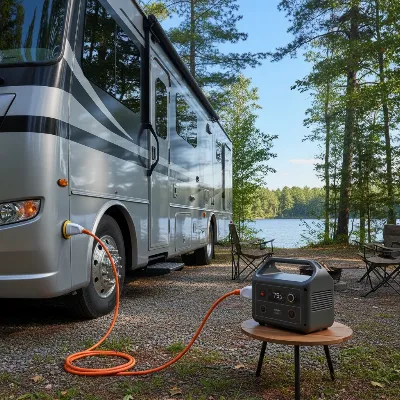 RV connected to power station with dogbone adapter, outdoor setting
Method 2: Integrated Connection with a Manual Transfer Switch (For Seamless Power)
For those seeking a more permanent and seamless integration, wiring your portable power station into your RV’s electrical system using a manual transfer switch is the advanced DIY method. This offers the ability to switch between shore power, a generator, or your power station with the flip of a switch, ensuring no backfeeding and safe operation.
What is a Manual Transfer Switch? A manual transfer switch is an electrical device that allows you to safely switch your RV’s entire 120V AC electrical panel between different power sources. It mechanically prevents two power sources from being connected simultaneously, thus eliminating the risk of backfeeding. For RVs, you’ll typically need a 30-amp or 50-amp rated transfer switch, depending on your RV’s service.
When to Use This Method: This approach is best if you plan to use your power station regularly as a primary off-grid power source, desire to power a wider range of appliances (within the power station’s capacity), and want a more integrated, less “cluttered” setup than constant plugging and unplugging. It requires a good understanding of electrical wiring.
Components Needed:
- Manual Transfer Switch: Rated for your RV’s amperage (e.g., 30-amp or 50-amp RV-specific model).
- Appropriate Gauge Wiring: To connect the power station to the switch and the switch to your RV’s main electrical panel.
- Inlet Receptacle: A male 15-amp (or 20-amp, if applicable) exterior power inlet installed on your RV, specifically for the power station.
- Mounting Hardware: For securing the transfer switch.
- Basic Electrical Tools: Wire strippers, screwdrivers, multimeter for testing.
Step-by-Step Installation (Overview):
- Safety First: Absolutely ensure all power to the RV is disconnected (shore power, battery disconnect) before beginning. Use a multimeter to confirm wires are dead.
- Choose Location: Select a dry, well-ventilated location inside your RV, ideally near your existing electrical panel, for mounting the manual transfer switch.
- Install Inlet Receptacle: Install a dedicated 15-amp (or 20-amp) male power inlet on the exterior of your RV. This will be where you plug your power station’s output into the RV system.
- Wire the Transfer Switch:
- Shore Power Input: The existing shore power line that currently feeds your RV’s main electrical panel will connect to the “Shore Power” input terminals on the transfer switch.
- Power Station Input: Run new, appropriately gauged wiring from your newly installed exterior inlet receptacle to the “Generator/Power Station” input terminals on the transfer switch.
- RV Panel Output: A new run of wiring will connect the “Output” terminals of the transfer switch to the main input of your RV’s electrical panel.
- Test Thoroughly: Once all connections are made and secured, carefully test the system. First, power on the power station and switch to its input, checking outlets. Then, switch to shore power, confirming proper operation. Use a multimeter to verify correct voltage and continuity, ensuring no crossed wires or short circuits.
- Professional Consultation: If any step seems unclear or beyond your comfort level, stop and consult a professional. The complexity of this wiring means that mistakes can be extremely dangerous.
Advantages: Offers seamless power switching, increased convenience, and enhanced safety by preventing backfeeding. It makes your power station an integral part of your RV’s energy ecosystem.
Disadvantages: This method is significantly more complex, requires electrical expertise, and involves making permanent modifications to your RV. It also requires the upfront cost of the transfer switch and additional wiring.
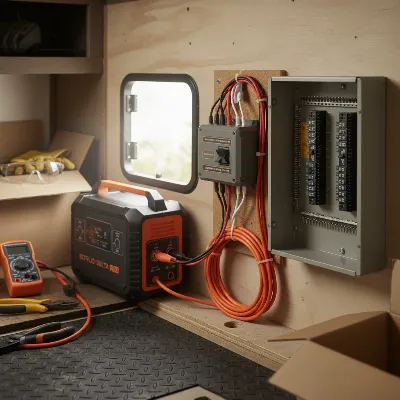 RV interior with manual transfer switch wiring for power station
Choosing the Right Portable Power Station for Your RV
Selecting the ideal portable power station is key to a successful setup. Here’s what to look for:
Power Output (Wattage) & Capacity (Wh):
- Wattage (W): This determines how many appliances, and which ones, you can run simultaneously. Add up the running wattage of the devices you plan to power. For most RVs, especially if you want to run a microwave or coffee maker, look for stations with a continuous output of 1800W or more.
- Capacity (Wh – Watt-hours): This dictates how long you can run your appliances before needing a recharge. A 2000Wh power station can run a 100W device for approximately 20 hours. Match this to your typical off-grid usage.
Outlet Types: Some advanced power stations now come with RV-specific 30-amp (TT-30R) outlets, eliminating the need for dogbone adapters for the simple plug-and-play method. This can greatly simplify connections and improve efficiency.
Battery Chemistry: While lithium-ion is common, Lithium Iron Phosphate (LiFePO4) batteries are increasingly popular for RV applications due to their longer lifespan (more charge cycles), enhanced safety, and better performance in a wider temperature range.
Charging Options: Look for versatile charging capabilities. Most power stations can charge from an AC wall outlet, your car’s 12V DC outlet, or, ideally, via solar panels. High solar input capacity is essential for extended off-grid stays.
Portability vs. Permanent Installation: Consider the weight and size if you plan to move the unit frequently. For a more integrated setup with a transfer switch, the power station might be semi-permanently installed, so weight might be less of a concern than dimensions.
Tips for Optimal Use and Maintenance
To ensure your portable power station serves you well for years, follow these usage and maintenance tips:
- Proper Charging Habits: Avoid consistently draining your power station to 0% and charging to 100%. For lithium-based batteries, keeping the charge between 20% and 80% can extend their overall lifespan. Follow the manufacturer’s specific recommendations.
- Storage Conditions: Store your power station in a cool, dry place, away from direct sunlight, extreme temperatures, and excessive humidity. Extreme heat or cold can degrade battery performance and lifespan.
- Regular Checks: Periodically inspect all cables, adapters, and connections for signs of wear, fraying, or corrosion. Replace any damaged components immediately.
- Monitor Load: Keep an eye on your power station’s display for current wattage output. Avoid consistently running it at its maximum capacity, as this can reduce efficiency and put strain on the unit.
- Firmware Updates: Some advanced power stations have firmware that can be updated. Check the manufacturer’s website for any recommended updates to improve performance or add features.
Conclusion
Connecting a portable power station to your RV opens up a world of clean, quiet, and flexible power options for your adventures. Whether you choose the simplicity of a direct plug-and-play setup for basic needs or opt for the seamless integration offered by a manual transfer switch, prioritizing safety is non-negotiable. By understanding your RV’s electrical demands, selecting the right power station, and adhering to proper installation and usage guidelines, you can confidently power your RV, enhancing your off-grid experiences without the reliance on noisy generators or limited shore power.
Are you ready to unplug from the grid and embrace the freedom of portable power in your RV?
Frequently Asked Questions
Can I power my RV’s AC unit with a portable power station?
|
Our Picks for the Best Power Station in 2026
As an Amazon Associate I earn from qualifying purchases.
|
||
| Num | Product | Action |
|---|---|---|
| 1 | Anker SOLIX C300 Portable Power Station with Car Charging Cable, Outdoor 288Wh LiFePO4 Battery, 300W (600W Surge) Solar Generator, 140W Two-Way Fast Charging, for Camping, Traveling, and Emergencies. |

|
| 2 | Anker SOLIX C1000 Gen 2 Portable Power Station, 2,000W (Peak 3,000W) Solar Generator, Full Charge in 49 Min, 1,024Wh LiFePO4 Battery for Home Backup, Power Outages, and Camping (Optional Solar Panel) |
|
| 3 | BLUETTI Portable Power Station AC180, 1152Wh LiFePO4 Battery Backup w/ 2 1800W (2700W peak) AC Outlets, 0-80% in 45Min, Solar Generator for Camping, Off-grid, Power Outage |
|
| 4 | Westinghouse 155Wh 150 Peak Watt Portable Power Station & Solar Generator, Modified Sine Wave AC Outlet, Backup Lithium Battery for Camping, Home, Travel, Indoor/Outdoor Use (Solar Panel Not Included) |
|
| 5 | 550W Power Station Compatible with Dewalt: LIVOWALNY Portable Generator DC 20V to AC 110-120V, Pure Sine Wave Power Inverter Battery Adapter Phone Charger 2 USB-A & 1 Type-C & 2 AC Outlet (Tool Only) |
|
| 6 | Jackery Explorer 2000 v2 Portable Power Station with 2x200W Solar Panels, 2042Wh LiFePo4 Battery, 2200W Solar Generator, 20ms UPS, USB-C PD 100W Fast Charging for Power Outages, Emergencies, Camping |
|
| 7 | UGREEN Power Strip Surge Protector with 4 Power Outlets, 15w Wireless Charger, 20W PD3.0 USB C Fast Charging, 2 USB-C Ports, 2 USB A Ports, Desk Charging Station for Office, Conference, Home Use |
|
| 8 | 550W Portable Power Inverter Compatible with Dewalt 20V Battery, Power Station DC 20V to AC 110V Pure Sine Wave, Battery Power Adapter 2USB&Type-C, Generator Phone Charger LED Light Camping Emergency |
|
| 9 | Anker SOLIX F3800 Portable Power Station, 3840Wh, LiFePO4 Batteries, Ultra-High 6000W AC Output with 120V/240V, Solar Generator for Home Backup, RVs, Emergencies, Power Outages, and Outdoor Camping |
|
| 10 | Anker SOLIX C1000 Portable Power Station, 1800W (Peak 2400W) Solar Generator, Full Charge in 58 Min, 1056wh LiFePO4 Battery for Home Backup, Power Outages, and Outdoor Camping (Optional Solar Panel) |
|
Yes, it is possible, but it requires a high-capacity portable power station with a significant wattage output (typically 2000W or more continuous output) and a large battery capacity. Smaller power stations are generally not sufficient for running an RV air conditioner, which is one of the highest-draw appliances in an RV. Always check your AC unit’s running wattage and compare it to the power station’s specifications.
What’s the difference between a portable power station and a generator for RVs?
A portable power station runs on batteries, providing silent, emission-free power through an inverter. It recharges via AC, DC, or solar. A traditional generator typically runs on gasoline, propane, or diesel, produces noise and exhaust fumes, and requires fuel. Power stations are favored for quiet operation and clean energy, while generators offer virtually unlimited runtime as long as fuel is available.
Do I need a pure sine wave inverter?
Yes, a pure sine wave inverter is highly recommended, and for many modern RV electronics, it’s essential. Pure sine wave output mimics grid power, ensuring that sensitive electronics like laptops, smart TVs, and medical devices operate correctly and are not damaged. Modified sine wave inverters can cause buzzing, overheating, and long-term damage to these appliances.
Is it safe to leave my power station plugged into my RV all the time?
If you are using the simple plug-and-play method with a dogbone adapter, it’s generally safe as long as the power station is properly ventilated and not overloaded. For an integrated setup with a manual transfer switch, it’s designed for continuous connection and safe switching. However, always monitor your power station’s charge levels and avoid over-discharging or over-charging, which can impact battery lifespan.
What size power station do I need for my RV?
The ideal size depends entirely on your power consumption habits. List all the appliances you intend to run and their wattage. Sum up the running watts for simultaneous use, and calculate your daily watt-hour (Wh) consumption. A larger Wh capacity provides longer runtimes, while higher wattage output allows you to run more powerful appliances. Consider a power station that exceeds your minimum requirements by 20-30% for flexibility.
